Introduction
Manhattan office vacancy hit 22% in Q3 2025, and CMBS office loan delinquencies climbed to 11.31% in December 2025. For landlords and asset managers, those numbers reflect real pressure: rising operating costs, thinning margins, and portfolios that demand sharper oversight than ever.
The question isn't whether to adapt — it's how. This guide breaks down what effective commercial real estate asset management looks like today: how it differs from property management, the core pillars that drive performance, and why combining analytics platforms with strategic human expertise is now essential to maximizing asset value and investor returns.
TLDR:
- CRE asset management focuses on financial strategy and long-term returns, not day-to-day operations
- Core responsibilities include financial tracking, lease administration, capital planning, and risk mitigation
- Modern technology platforms automate reporting and enable predictive analytics to identify risks early
- Integrated service partners — combining asset management, leasing, and construction — deliver faster, more cost-effective results
- Deep local market expertise gives landlords a competitive edge in tenant acquisition
What Is Commercial Real Estate Asset Management?
Commercial real estate asset management is the strategic process of overseeing and optimizing the financial performance of investment properties throughout their full lifecycle—from acquisition and leasing through operations and eventual disposition.
Asset managers work on behalf of property owners, landlords, or institutional investors to set and execute investment strategy, monitor performance, and maximize long-term returns.
The role is fundamentally different from the day-to-day operational focus of a property manager. According to IREM's industry definition, asset management centers on financial oversight and strategic decision-making that serves the investment's broader objectives.
The scope of CRE asset management spans multiple property types:
- Office — highest complexity, especially in dense urban markets
- Retail — heavily influenced by foot traffic and anchor tenant mix
- Industrial — driven by supply chain demand and lease duration
- Multifamily — focused on occupancy rates and rent growth
In New York City, office asset management carries particular weight. Tight lease structures, high buildout costs (Manhattan's top 10 deals in 2024 averaged $127.70 per square foot in tenant improvements), and tenants recalibrating space needs around hybrid work all add layers of complexity that other markets rarely see.
Asset Management vs. Property Management: Key Differences
The two roles are frequently confused, but their focus and responsibilities differ sharply.
Property management covers day-to-day operations:
- Building maintenance and repairs
- Rent collection and lease enforcement
- Tenant communications and issue resolution
- Vendor and contractor management
- Day-to-day staffing and security
Asset management drives investment strategy:
- Financial performance tracking and reporting
- Portfolio-level investment decisions
- Acquisition due diligence and disposition planning
- Securing and negotiating financing with lenders
- Setting capital improvement budgets
- Advising on legal and tax implications of ownership
Core Asset Manager Responsibilities
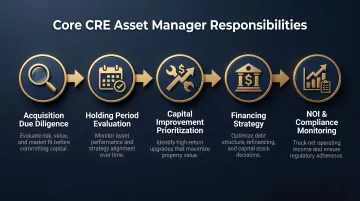
CRE asset managers operate across the full investment lifecycle. Key responsibilities include:
- Conducting due diligence on potential acquisitions
- Evaluating holding periods based on market cycles
- Prioritizing capital improvements that deliver measurable ROI
- Structuring financing strategies to optimize portfolio returns
- Monitoring net operating income (NOI), occupancy trends, and lender covenant compliance
The Blurring Lines
In modern CRE practice, these roles are beginning to converge. Property managers are now expected to provide financial analysis and performance insights once reserved for asset managers, driven by more accessible software platforms and real-time data tools. For owners, that means a single point of contact can now surface both operational issues and the data needed to act on them.
Portfolio vs. Property Focus
Asset managers make decisions that serve the overall portfolio's health. That might mean accepting lower returns on one asset to improve financing terms across several others, or timing a disposition to rebalance risk exposure. Property managers stay focused on one thing: maximizing performance and tenant satisfaction at the individual property level.
Core Pillars of Effective CRE Asset Management
Financial Analysis and Performance Tracking
Financial oversight is the foundation of effective asset management. Asset managers track net operating income (NOI), cash flow, operating expenses, and occupancy rates to benchmark each asset's contribution to the overall portfolio. Consistent reporting also satisfies lender compliance requirements and provides transparency to investors.
With US commercial real estate investment volume reaching $499 billion in 2025, institutional investors demand granular visibility into performance metrics. Asset managers must deliver accurate, timely reporting that supports decision-making at both the property and portfolio levels.
Lease Administration and Tenant Management
Proactive lease management protects against revenue leakage and vacancy risk. This includes:
- Monitoring renewal timelines and triggering early negotiations
- Tracking rent escalations and ensuring compliance
- Identifying lease expiration concentration risk
- Managing tenant improvement allowances and buildout budgets
Strong tenant relationships drive retention, which directly supports stable NOI. Revenue leakage in property management can reach 3-7% when lease compliance isn't monitored closely—a preventable loss that asset managers must control.
Property Valuation and Capital Planning
Asset managers continuously assess current market value and plan capital improvements that deliver measurable ROI. This balancing act requires:
- Maintaining adequate maintenance reserves
- Prioritizing strategic upgrades that enhance property appeal
- Evaluating market-driven amenity investments
- Timing capital deployment to market conditions
In competitive NYC submarkets like NoMad and Flatiron, landlords must invest strategically in tenant amenities, building infrastructure, and space flexibility to attract quality tenants and command premium rental rates.
Acquisition and Disposition Strategy
Those capital planning decisions feed directly into acquisition and disposition strategy — knowing when a property has hit its value ceiling informs the sell decision just as much as market conditions do. Asset managers evaluate when to buy, hold, or sell based on market cycles, financing conditions, and alignment with the investor's return objectives. Manhattan investment sales surged 45% to $22.77 billion in 2025, signaling renewed investor confidence and increased transaction activity across the borough.
Risk Assessment and Mitigation
Early risk identification — tenant default, lease expiration concentration, market softening, deferred maintenance — gives asset managers room to act before problems compound. Reactive responses cost more and recover less.
Key risk mitigation tactics include:
- Diversifying tenant mix to reduce concentration risk
- Structuring leases with staggered expiration dates
- Maintaining adequate capital reserves for unexpected expenses
- Conducting regular property inspections and financial audits
The Modern Approach: How Technology Is Reshaping CRE Asset Management
Spreadsheets and fragmented data sources are no longer sufficient for managing complex commercial portfolios. Today's asset managers rely on real-time dashboards, automated reporting, and AI-assisted analytics to stay ahead of performance issues before they become problems.
Predictive Analytics and AI
Machine learning models analyze historical lease performance, market trends, and tenant behavior to forecast risks like vacancy spikes or loan defaults before they materialize. This enables proactive strategy adjustments rather than crisis response.
According to JLL's 2025 CRE Technology Survey, the percentage of real estate firms running AI pilots jumped from just 5% to 92% in three years. Yet Deloitte's 2025 CRE outlook finds that 76% of organizations still consider their AI adoption early-stage — meaning most firms are only beginning to tap what these tools can do.
Automation Cuts Operational Overhead
Automation handles the repetitive work — expense tracking, lease renewal alerts, compliance monitoring, financial report generation — reducing human error and freeing asset managers for lease negotiations, investor relations, and portfolio strategy. The PropTech market is projected to reach $53.24 billion by 2026, growing at a CAGR of 17.79%, driven largely by demand for these efficiency gains.
Centralized, Collaborative Data Platforms
In multi-property portfolios managed by teams, a shared data environment improves communication, speeds up deal-making, and ensures every stakeholder — from asset managers to property managers to lenders — is working from the same information. The practical benefits compound quickly:
- Eliminates version control issues across distributed teams
- Reduces reporting lag between property managers and ownership
- Supports faster, more confident decisions at every level
Risk Management Strategies for CRE Asset Managers
CRE asset managers navigate two major risk categories:
Market Risk:
- Property valuation shifts driven by economic conditions
- Rising vacancy rates and declining rental demand
- Economic downturns affecting tenant creditworthiness
- Interest rate changes impacting financing costs
Operational Risk:
- Tenant defaults and lease non-compliance
- Deferred maintenance accumulating into capital liabilities
- Lease expiration concentration creating sudden vacancy exposure
- Financing stress at loan maturity
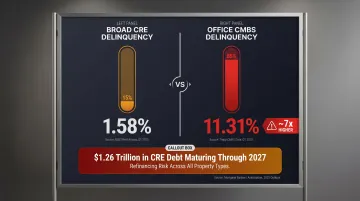
These aren't abstract risks — current market data reflects both in real time. CRE loan delinquency rates reached 1.58% in Q4 2025 across all commercial real estate, while office CMBS delinquency hit 11.31%—more than seven times the broader CRE average. With $1.26 trillion in CRE debt maturing through 2027, refinancing risk is acute.
Proactive Risk Mitigation Tactics
- Diversify tenant mix across industries, company stages, and lease term lengths to reduce concentration risk
- Stagger lease expirations to avoid renewal cliffs where multiple large tenants expire at once
- Maintain capital reserves for unexpected repairs, tenant improvements, and market downturns
- Schedule regular property inspections and financial reviews to catch issues before they compound
NYC Office Market Considerations
In the NYC office market, risk management requires a clear read on hybrid work adoption. Global office utilization reached 54% in 2025, while CBRE reported 53% utilization with peak days reaching 80%.
That utilization gap shapes everything downstream — from how tenants size their space to how aggressively landlords must compete on tenant improvement allowances and lease flexibility. Asset managers who track these patterns early can position their properties ahead of market pressure rather than react to it.
Choosing the Right CRE Asset Management Partner
Selecting the right asset management partner is critical. Look for:
- Neighborhood-level market knowledge in your target geography and asset class — not just city-wide familiarity
- A track record spanning both growth periods and downturns, not just recent bull-market wins
- Consistent, detailed financial reporting with clear KPIs and timely communication
- Coverage across the full lifecycle: acquisition due diligence, lease administration, capital planning, and disposition
The right partner will check most of these boxes. The best ones check all of them through a single integrated platform.
The Value of a Full-Service Partner
Firms that handle asset management alongside leasing, construction, and facilities management offer more coherent execution. Strategy and operations stay aligned from day one, rather than being divided across disconnected vendors — which cuts coordination costs and reduces communication gaps.
Nomad Group's end-to-end platform works this way in practice. When an asset manager identifies the need for a capital improvement to attract tenants, the same team can design, budget, and execute the buildout. No separate architects, no separate contractors, no delays from handoffs between vendors.
Local Expertise Matters
For landlords and investors in NYC's high-growth office market, a partner with deep neighborhood-level expertise—covering areas like NoMad, Flatiron, SoHo, and Williamsburg—and relationships with high-growth tenants brings a clear competitive advantage in leasing and asset performance. Local knowledge translates to faster lease-up, stronger tenant quality, and better negotiation outcomes.
Frequently Asked Questions
What is commercial real estate asset management?
Commercial real estate asset management is the strategic oversight of commercial properties to maximize financial performance and long-term investment returns. It covers the full lifecycle from acquisition through disposition, focusing on financial analysis, lease administration, and portfolio optimization.
How does an asset management company (AMC) make money?
Asset management companies typically earn revenue through management fees (usually 1-2% of asset value or gross revenue), performance-based fees tied to returns achieved, and sometimes acquisition or disposition fees charged at transaction points.
What is the difference between CRE asset management and property management?
Property management handles daily operations like maintenance, rent collection, and tenant issues. Asset management focuses on strategic financial performance, portfolio planning, acquisitions, and long-term return optimization—setting the investment strategy that property managers execute.
What are the key responsibilities of a commercial real estate asset manager?
Core duties include financial analysis and reporting, lease administration, capital improvement planning, acquisition and disposition strategy, risk assessment, and lender compliance—all focused on maximizing property value and investor returns.
How does technology improve commercial real estate asset management?
Modern CRE tech platforms automate reporting, enable real-time portfolio monitoring, and apply predictive analytics to identify risks early. The result is faster, better-informed leasing and capital decisions — without the errors that come with manual processes.
What should I look for when choosing a CRE asset management partner in NYC?
Look for a partner who checks these boxes:
- Local market expertise across NYC's specific submarkets (Flatiron, NoMad, SoHo, etc.)
- Integrated services that coordinate leasing, construction, and operations under one roof
- Transparent reporting with clear visibility into performance and fees
- Proven track record across asset types and multiple market cycles
- Strong relationships with tenants and lenders in your target geography
Firms like Nomad Group, which manages 2M+ square feet across NYC and offers end-to-end services from brokerage to facilities management, illustrate what that integrated model looks like in practice.