
This document does more than formalize a showing. It establishes who the broker represents, which properties are covered, and what fee obligations (if any) the tenant may carry. In a market like Manhattan, where multiple brokers routinely show the same spaces and commission disputes are an occupational hazard, that paperwork matters.
This article covers what a commercial touring agreement actually is, what it includes, how it differs from the residential version you may have heard about, and what to check before you put your signature on it.
Key Takeaways
- A property touring agreement is signed before a broker shows you commercial space — it defines who they represent and the showing's terms.
- In NYC, landlords typically cover broker commissions for both sides, so tenants rarely pay out of pocket.
- It governs a specific showing or set of showings — not a lease, letter of intent, or exclusive representation contract.
- Review property scope, term length, representation disclosures, and any fee-shift provisions before signing.
- A tenant-side broker can flag problematic terms in a touring agreement before you're locked into anything.
What Is a Property Touring Agreement in Commercial Real Estate?
Most tenants sign one before they even realize what it covers. A property touring agreement is a written document signed between a prospective tenant and a commercial real estate broker (or brokerage firm) before physically viewing office, retail, or industrial space. It formalizes the relationship and sets the ground rules for that showing.
To understand why it exists, you need to understand how broker representation works in commercial real estate. A broker may represent:
- The landlord (listing broker) — their job is to fill the space on the best terms for the owner
- The tenant (tenant's broker) — their job is to advocate for your interests
- Both parties (dual agent) — permissible in New York with written consent, but limited in how fully either side can be represented
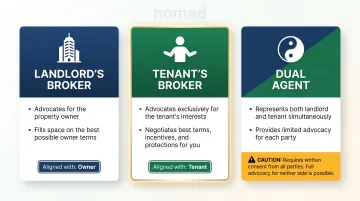
The touring agreement is often the first place this representation gets disclosed. That disclosure matters enormously. If you tour a space through a listing broker without understanding who they work for, you may walk into lease negotiations without anyone in your corner.
What This Document Is Not
This is a narrow document. It is not:
- A lease or letter of intent
- An exclusive tenant representation agreement
- A commitment to lease any particular space
It governs the act of touring — and potentially the brokerage relationship stemming from it — within a defined scope and timeframe.
Why NYC Makes This Especially Important
Manhattan leasing reached 41.92 million square feet in 2025, with availability tightening to 13.9% by year-end. In a market that active, brokers frequently co-broker deals and the same space may be shown by multiple firms.
A touring agreement creates a documented record of who introduced a tenant to a specific property — the foundation of procuring cause claims when commission disputes arise. Under New York law, a broker can earn a commission simply by being the procuring cause of a deal, meaning brokerage agreements can even be oral. For tenants, a written touring agreement is the clearest protection against getting caught in the middle of those disputes.
Key Elements of a Commercial Property Touring Agreement
Not all touring agreements look the same. Commercial versions are less standardized than their residential counterparts and vary by firm, property type, and market. Here's what to look for in each section.
Parties Involved
A touring agreement typically names the prospective tenant — the company, not just an individual — and the brokerage firm as the two parties, not the individual agent. In commercial deals, that distinction matters. That distinction establishes which firm holds the right to claim procuring cause or a commission credit if the deal closes.
Property Scope
The scope can be written narrowly (a specific address or suite) or broadly (a neighborhood, a square footage range, or multiple buildings across Manhattan). Before signing, confirm exactly which properties are covered.
This clause deserves close attention if you're planning to tour spaces through more than one broker. A broadly written scope could create commission obligations on properties you didn't intend to cover with that firm.
Term of the Agreement
The term defines how long the agreement remains valid — anywhere from a single-day showing to several months. The right length depends on where you are in the process:
- Shorter terms give more flexibility during early, exploratory searches
- Longer terms make sense once you're actively evaluating specific buildings and have a clear requirement
Avoid vague or open-ended terms. A defined start and end date protects both parties.
Broker Compensation and Fee Disclosures
In most NYC commercial leasing transactions, landlords pay broker commissions — typically structured as a declining percentage of aggregate base rent, split between the listing broker and the tenant's broker. Tenants generally do not pay broker fees directly.
Some touring agreements include a fee-shift clause: if no landlord commission is paid (common in certain sublease situations), the tenant may be responsible for compensating their broker. Read this clause carefully and ask your broker to explain any provision that places a fee obligation on you.
Commercial vs. Residential Touring Agreements: Key Differences
If you've recently bought a home, you may have encountered a buyer-broker agreement before touring properties. Commercial touring agreements work quite differently — they operate under a separate legal framework with different obligations on both sides.
| Dimension | Residential (NAR/MLS context) | Commercial (NYC office) |
|---|---|---|
| Written agreement required | Yes, as of August 17, 2024 for MLS Participants | Not mandated by NAR; common in practice |
| Who pays the broker | Active debate post-NAR settlement | Landlord typically pays both sides |
| Governing body | NAR policies + state law | NY Department of State, RPL 443 |
| Standardization | Higher — more uniform consumer forms | More negotiable, firm-specific terms |
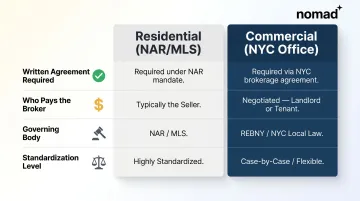
The NAR settlement that took effect in August 2024 required written buyer agreements before residential home tours and explicitly does not govern commercial transactions. Commercial real estate in New York operates under its own licensing framework — the NY Department of State and Real Property Law Section 443 — not NAR policy.
That regulatory distinction has a real impact on how broker compensation works. As a commercial tenant in NYC, you're unlikely to be asked to personally cover broker fees — the landlord typically pays both sides. What the framework doesn't do is make every clause in a touring agreement automatically favorable to you.
A few provisions worth scrutinizing before you sign:
- Exclusivity scope — some agreements limit which properties your broker can show you, restricting your options
- Duration — open-ended terms can lock you into a relationship longer than your search timeline requires
- Fee triggers — language tying commission to any lease signed (not just leases your broker sources) can create unexpected liability
What to Check Before Signing
Before you sign a commercial touring agreement, review these four areas:
1. Confirm who the broker represents. Is it you, the landlord, or both? New York permits dual agency only with informed written consent — and it limits how fully the broker can advocate for either side.
2. Narrow the property scope. Limit the agreement to the specific properties or buildings you intend to tour with that broker. A broad scope can create unintended commission obligations if you work with multiple brokers or approach landlords directly.
3. Check the term length and exit conditions. Look for a defined start and end date. Confirm whether the agreement auto-renews and how either party can terminate it.
4. Read the fee provisions carefully. Verify what happens if the landlord doesn't pay a commission. Understand whether any out-of-pocket obligation would fall to you, and for how much.
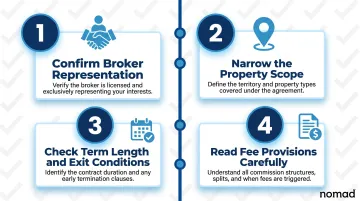
These terms are easy to overlook when you're eager to start touring — but they're worth a close read before you commit.
A tenant-side broker reviews these terms with you before you sign anything — and stays in your corner through search, negotiation, and buildout. That's the model Nomad Group is built on: tenant representation for high-growth NYC companies that need more than a transaction.
Frequently Asked Questions
What is a property touring agreement?
It's a written document signed between a prospective tenant and a real estate broker or brokerage firm before viewing a property. It establishes the terms of the showing and discloses who the broker represents.
Do you have to pay a broker to tour commercial office space?
In most NYC commercial transactions, landlords typically cover broker commissions for both sides of the deal. That said, always review the fee section of any touring agreement to confirm no out-of-pocket showing fee applies to your situation.
Is a commercial property touring agreement legally binding?
Yes. A signed touring agreement is a binding document and may create commission obligations if you later lease a property covered by the agreement — even if you engage a different broker. Read it before signing.
Can you tour commercial office spaces without signing a touring agreement?
Sometimes. Direct landlord contact or open-house style events may not require one. But when working with a tenant broker, most firms require a signed agreement before showing spaces — and having that documentation actually protects your representation status.
How does a commercial touring agreement differ from a residential buyer's touring agreement?
Commercial agreements aren't governed by NAR settlement rules, and the landlord almost always pays the commission — not the tenant. They're also significantly less standardized and more negotiable than the residential versions introduced after August 2024.