
Introduction
When a startup signs its first real NYC office lease, most of the attention goes to rent, layout, and location. But once the lease is signed and the space is designed, a harder challenge sets in: keeping that space functional, safe, and productive month after month. That's office facility management (OFM) — the operational layer most growing companies ignore until something breaks.
Unlike office design or lease negotiation, facilities management works in the background. It's why your HVAC runs in July, your electrical systems pass inspection, and a burst pipe doesn't shut down your workday.
In NYC — where operating costs average $28.67 per square foot (the highest in the nation) and regulatory compliance spans at least seven Local Laws — OFM isn't a maintenance checkbox. It's a strategic function that directly affects operating costs, employee retention, and your ability to keep the doors open.
This guide covers what office facility management is, what it includes, who manages it, and why it matters especially for companies scaling in complex urban markets like New York City.
TLDR
- Office facility management maintains and optimizes physical workspace so it stays safe, functional, and productive
- Covers both "hard" services (HVAC, electrical) and "soft" services (cleaning, security, reception)
- Facilities managers oversee the built environment; office managers focus on people and admin
- Effective FM reduces costs through preventive maintenance — typically far cheaper than reactive emergency repairs
- Most NYC companies outsource FM to manage regulatory complexity and control $28.67 PSF operating costs
What Is Office Facility Management?
Office facility management is the organizational function that integrates people, place, and process within the built environment to maintain safety, functionality, comfort, and efficiency. IFMA explicitly adopts the ISO 41011 definition: "Facility Management is an organizational function which integrates people, place and process within the built environment with the purpose of improving the quality of life of people and the productivity of the core business."
How Office FM Differs From Industrial FM
Office FM focuses specifically on the workplace, where knowledge workers operate. Unlike industrial or warehouse facility management, which prioritizes production uptime and equipment throughput, OFM centers on:
- Space utilization and occupancy efficiency
- Employee comfort and environmental quality
- Operational uptime for business continuity
- Regulatory compliance and safety
The Full Scope of OFM
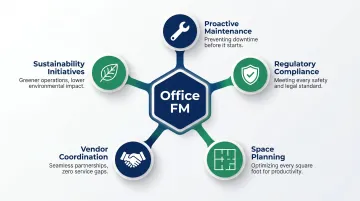
Office facility management spans five core operational areas:
- Proactive maintenance : scheduled inspections and preventive upkeep before failures occur
- Regulatory compliance : tracking building codes, fire safety, ADA standards, and inspection deadlines
- Space planning : evaluating how the office is used and supporting reconfiguration as teams grow
- Vendor coordination : managing relationships with HVAC techs, cleaners, electricians, security firms
- Sustainability initiatives : monitoring energy use and supporting environmental goals
Integrated Facilities Management (IFM)
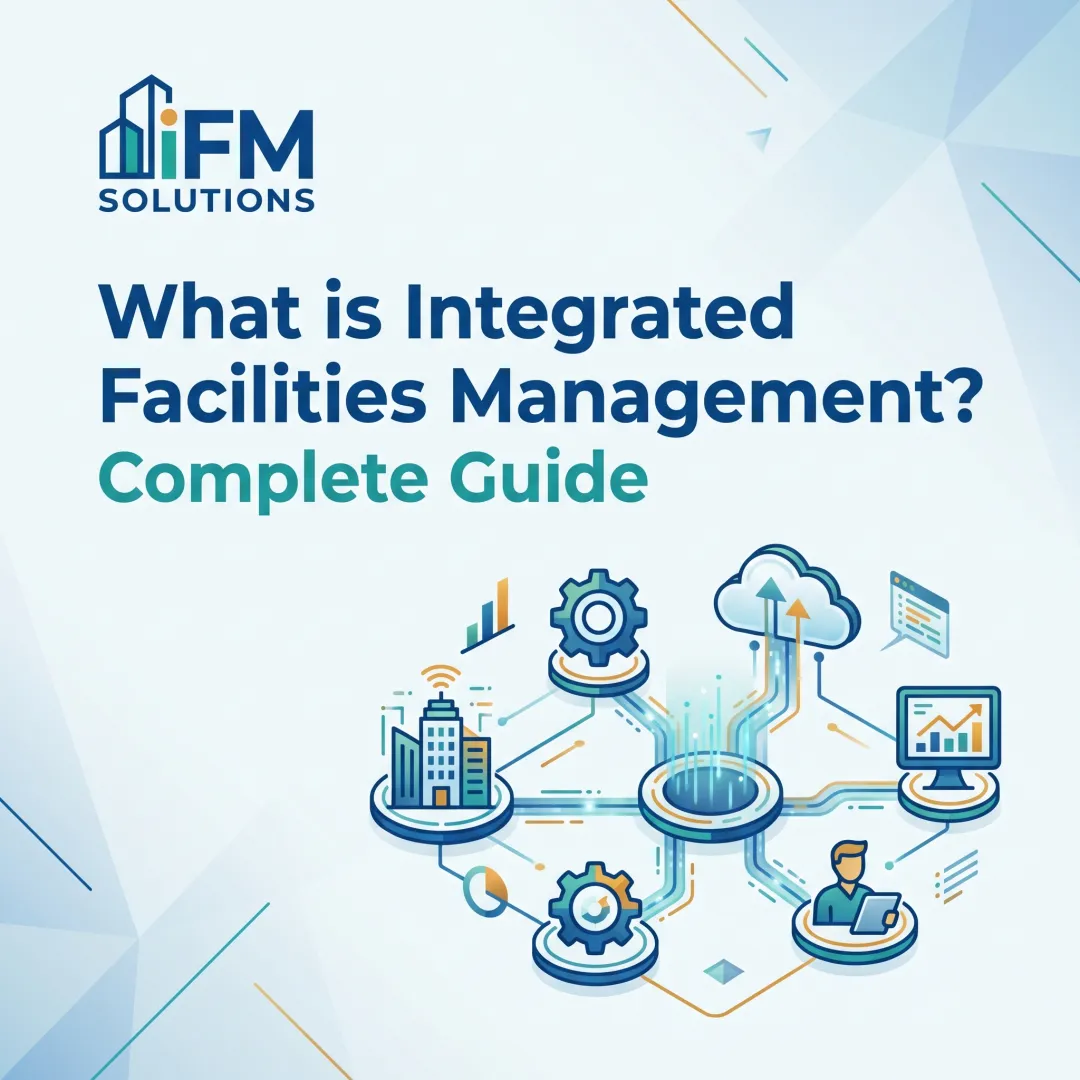
IFM consolidates multiple facility management functions (typically handled by separate vendors or departments) under a single coordinating provider. This improves consistency, accountability, and cost efficiency by eliminating coordination friction and simplifying oversight.
Why OFM Matters More Now
That consolidation matters more than ever as hybrid work has reshaped how offices are used. CBRE's 2026 report shows global building utilization reached 53%, up from 35% in 2023, with 89% of organizations operating formal hybrid programs. At the same time, design density has compressed to 190 sq ft/seat — offices are being asked to do more with less floor space per person.
In NYC specifically, where real estate commands the highest operating costs in the country at $28.67 per square foot, facility management has become a strategic function. Every dollar saved on preventive maintenance, every avoided compliance penalty, and every hour of unplanned downtime prevented translates directly to ROI.
Core Responsibilities of an Office Facilities Manager
Facilities Manager vs. Office Manager
An office manager facilitates the people: supplies, scheduling, admin support, and day-to-day coordination. A facilities manager is responsible for the place — the building systems and physical environment that surround those people.
Put simply: the office manager adjusts the thermostat. The facilities manager is the reason there's heat at all.
Building Operations and Maintenance
The FM oversees:
- HVAC systems — heating, cooling, and ventilation
- Electrical systems — power distribution, lighting, emergency generators
- Plumbing — water supply, drainage, restrooms
- Elevators and access control — vertical transport and building security
- Fire safety systems — alarms, sprinklers, extinguishers
In NYC high-rises, this often involves coordination with building management and multiple licensed trade contractors. The FM schedules preventive maintenance to avoid breakdowns and responds to reactive repairs when issues arise.
Compliance and Safety Management
Keeping the building legal is its own full-time job. Facilities managers track building codes, fire safety requirements, ADA standards, and inspection deadlines — in NYC, across a layered regulatory environment with no single filing portal:
| NYC Compliance Requirement | Applicable Buildings | Cycle | Key Deadline |
|---|---|---|---|
| LL97 (GHG Emissions) | >25,000 sq ft | Annual reporting | May 1 annually |
| LL87 (Energy Audits) | >50,000 sq ft | Every 10 years | December 31 of filing year |
| LL11/FISP (Facades) | >6 stories | Every 5 years | Cycle-dependent |
| Boiler Inspections | All commercial buildings | Annual | Within calendar year |
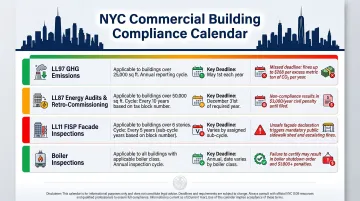
Missing a single deadline can trigger fines or stop-work orders — which is why tracking these obligations is a dedicated FM responsibility, not an afterthought.
Space Planning and Resource Allocation
As companies grow or downsize, FMs work with leadership to make the space work harder:
- Evaluate how the office is being used
- Identify underutilized areas
- Support reconfiguration as teams grow
- Ensure the layout supports the way people actually work
Vendor and Contractor Management
A significant portion of FM work involves managing relationships with service providers:
- HVAC technicians
- Cleaning crews
- Security firms
- Electricians
- Plumbers
The FM vets each provider, sets performance expectations, oversees service quality, and manages contracts and invoicing. In a market like NYC — where specialized trade contractors are in high demand — having reliable vendor relationships is often what separates a well-run building from one in constant crisis mode.
Hard vs. Soft Facility Management: What Services Are Included
Office FM services are typically categorized as "hard" or "soft." IFMA distinguishes these as follows: hard FM ensures the building performs; soft FM ensures the people inside thrive.
Hard Facility Management Services
Hard FM refers to services tied to the physical structure and building systems — things that cannot easily be removed:
- HVAC maintenance and repair — seasonal tune-ups, filter changes, emergency repairs
- Electrical systems — panel upgrades, circuit repairs, lighting maintenance
- Plumbing — pipe repairs, fixture replacements, water heater service
- Structural maintenance — roof repairs, facade inspections, foundation work
- Fire safety systems — alarm testing, sprinkler inspections, extinguisher service
- Elevators and access control — lift maintenance, card reader systems, security hardware
These require licensed contractors and directly affect whether the space is safe and habitable.
Soft Facility Management Services
Soft FM refers to people-centric or "housekeeping" services that support the work environment without being structural:
- Commercial cleaning and janitorial services — daily cleaning, trash removal, restroom upkeep
- Security and front-of-house management — reception, visitor management, access monitoring
- Waste management — recycling programs, waste disposal coordination
- Pest control — regular inspections and treatment
- Mail and reception services — package handling, courier coordination
- Catering/pantry management — kitchen restocking, appliance maintenance
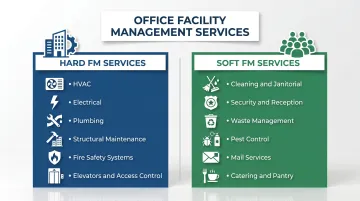
These services shape how the office actually feels day-to-day. Functional HVAC keeps a building operational — but consistent cleaning, stocked kitchens, and attentive front-of-house staff are what make people want to show up.
The 4 Pillars of Office Facility Management
The four-pillar framework — people, process, technology, and the physical workplace — provides a practical way to evaluate whether a company's FM approach is complete. While not an official IFMA standard (IFMA publishes 11 core competencies), this shorthand is widely used across the industry.
People
Includes the facilities team itself, the vendors they manage, and the end-users (employees) whose needs shape FM priorities. Effective FM requires clear communication between all three groups.
Process
Structured procedures for:
- Routine inspections
- Work order management
- Emergency response
- Compliance tracking
Without documented processes, FM becomes reactive. Reactive maintenance costs more, takes longer, and creates more disruption than planned upkeep. Those processes also set the foundation for the tools that support them.
Technology
FM teams typically rely on:
- CMMS (Computerized Maintenance Management Systems) — software that schedules maintenance tasks and tracks work orders
- CAFM (Computer-Aided Facilities Management) — software enabling FMs to plan and monitor space management
- Building management systems — platforms that monitor HVAC, lighting, and security in real time
Physical Workplace
The space itself must be designed and maintained to support the other three pillars. A poorly laid-out floor plan, aging HVAC, or a backlog of deferred repairs creates friction that no process or platform can fully offset. In practice, physical workplace quality is often where FM success or failure becomes most visible to employees.
Benefits of Effective Office Facility Management
Employee Productivity and Satisfaction
Workplace quality directly affects employee engagement. Gallup reports that U.S. employee engagement fell to 31% in 2024 — a 10-year low — with global disengagement costing an estimated $10 trillion in lost productivity. While engagement is influenced by many factors, workplace conditions are one lever FM teams can directly control.
Leesman data shows that only 35% of employees are satisfied with noise levels and only 41% are satisfied with temperature control — both within FM's direct control. Meanwhile, 89% rate "individual focused work" as their most important activity, making environmental quality a critical FM deliverable.
Cost Control and Operational Efficiency
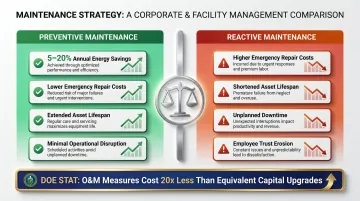
The U.S. Department of Energy estimates that organizations can save 5-20% annually on energy bills simply by following preventive maintenance best practices for commercial HVAC equipment. The DOE also notes that O&M measures cost about 20 times less than equivalent energy efficiency upgrades while achieving roughly the same energy savings.
Preventive maintenance, in particular, delivers compounding returns:
- Reduces emergency repair costs before failures escalate
- Extends the lifespan of building assets like HVAC, elevators, and plumbing
- Prevents unplanned downtime — a failed AC in July or a flooded bathroom — that erodes employee trust and disrupts operations
Business Continuity and Risk Management
Facilities management ensures the office meets health, safety, and compliance requirements, reducing the risk of:
- Regulatory violations and fines
- Workplace accidents and liability claims
- Insurance coverage gaps
- Operational shutdowns due to failed inspections
In New York City, these risks carry extra weight. Requirements like Local Law 97 carbon emissions reporting and NYC Department of Buildings compliance add regulatory layers that most markets don't face — making proactive FM a necessity, not a nice-to-have.
In-House vs. Outsourced Facility Management for Growing NYC Companies
The Two Models
The choice comes down to two structures: in-house FM, where you hire a dedicated facilities manager or team internally, and outsourced FM, where you partner with a third-party provider that bundles FM with other services.
Most early-stage and mid-size companies don't have the volume to justify a full-time in-house FM team. IFMA's FM Pulse Report found that 37% of facility managers increased outsourcing, driven by staffing shortages averaging 3.7 months to fill vacancies.
The Case for Outsourcing in NYC
NYC's regulatory environment, density of building systems, and high cost-per-square-foot make facility management more complex than in most markets:
- Operating costs: NYC's $28.67 PSF is 82% above the national average of $15.76
- Regulatory density: At least seven sustainability-specific Local Laws plus annual boiler inspections, five-year facade cycles, and ongoing building code compliance
- Contractor coordination: Licensed trade contractors across HVAC, electrical, plumbing, fire safety, and elevator systems — each requiring separate relationships and contracts
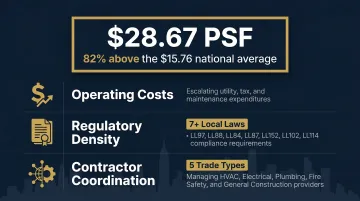
Outsourcing to a partner with deep local market knowledge — including relationships with licensed contractors across trades — often delivers better outcomes at lower cost than building an internal capability from scratch.
Where Nomad Group Fits
That local knowledge is exactly where Nomad Group operates. For high-growth companies that have already leased and built out NYC office space, Nomad Group's facilities management service takes over the operational layer — handling vendor coordination, maintenance oversight, and day-to-day building compliance so founders and operations teams can focus on the business itself.
Frequently Asked Questions
What is office facility management?
Office facility management is the organizational function responsible for maintaining, operating, and optimizing a physical office environment. It covers everything from building systems and compliance to space planning and vendor oversight, ensuring the workspace stays safe, functional, and productive.
What does an office facilities manager do?
A facilities manager oversees the built environment — building systems, maintenance, compliance, space planning, and vendor management. This role is distinct from an office manager, who focuses on people and administrative operations like scheduling and supplies.
What services are included in facilities management?
Facilities management includes both hard services (HVAC, electrical, plumbing, fire systems, elevators) and soft services (cleaning, security, reception, waste management, pest control). The exact mix depends on the size and complexity of the office.
What are the 4 pillars of facilities management?
The four pillars are people, process, technology, and the physical workplace. Each pillar plays a distinct role: the right team executes, sound processes guide decisions, technology enables visibility, and the physical space supports how work actually gets done.
What is integrated facilities management?
Integrated facilities management (IFM) consolidates multiple FM functions typically handled by separate vendors or departments, under a single coordinating provider. This improves consistency and accountability while cutting the time spent managing multiple contracts.
What is workplace and facilities management?
Workplace management covers how people use space — occupancy, desk booking, collaboration zones. Facilities management covers the physical infrastructure keeping it running: HVAC, electrical, plumbing, and cleaning. Most organizations manage both together because the two directly affect each other.