Introduction
Picture this: A Series A startup signs a lease for 8,000 square feet in NoMad, completes a custom buildout in 90 days, and moves the team in — only to discover that keeping the HVAC running, coordinating janitorial services, scheduling elevator inspections, and tracking down an electrician when the circuit breaker trips feels like a second full-time job. Without a dedicated operations team, the founders find themselves fielding maintenance calls instead of closing deals.
Commercial facility management solves this problem. It's the discipline that bridges the gap between leasing great office space and keeping it operational, compliant, and cost-effective over time. For fast-growing NYC companies navigating hybrid work, regulatory complexity, and real estate as their second-largest expense, the quality of facility management directly impacts productivity, safety, and operating costs.
This guide covers what commercial FM is, how hard and soft services work together, key responsibilities facility managers handle, how FM differs from property management, and what strong facility management looks like for companies scaling in New York City.
TLDR
- Commercial FM oversees a building's physical systems and services to keep it safe, functional, and compliant
- Splits into hard FM (HVAC, electrical, structural) and soft FM (cleaning, security, space planning)
- FM prioritizes occupant experience; property management prioritizes the owner's financial return
- For scaling companies, strong FM cuts operating costs and keeps leadership focused on growth — not broken circuit breakers
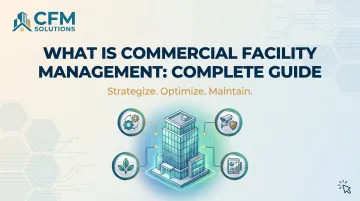
What Is Commercial Facility Management?
Commercial facility management is the ongoing discipline of maintaining, operating, and optimizing a commercial property's physical infrastructure and support services so the business inside can operate without disruption. ISO 41011:2017 defines facility management as integrating "people, place, and process within the built environment" to improve quality of life and core business productivity. Unlike residential maintenance — where a failure affects one household — a commercial FM breakdown can halt business operations entirely.
Commercial FM applies to any property used for business purposes — office buildings, retail spaces, warehouses, manufacturing plants, and mixed-use developments. Core responsibilities include:
- HVAC, electrical, and plumbing systems
- Fire safety and life safety compliance
- Cleaning, security, and waste management
- Space planning and asset lifecycle tracking
- Vendor coordination and budget management
Commercial FM also carries greater regulatory complexity than residential maintenance: OSHA workplace safety requirements, ADA accessibility standards, and local building codes all apply. The systems themselves are more sophisticated, and the tolerance for downtime is far lower.
Facility managers work on two tracks simultaneously:
- Operational — scheduling repairs, coordinating vendors, managing cleaning and security on a day-to-day basis
- Strategic — equipment lifecycle budgeting, sustainability programs, and long-term capital planning
FM responsibilities can be handled in-house, outsourced to a third-party provider, or structured as a hybrid. The right model depends on company size, growth stage, and operational complexity — for scaling companies, outsourcing typically delivers better outcomes than building internal FM capacity from scratch.
Hard FM vs. Soft FM: The Two Core Categories
The hard FM / soft FM framework is the standard industry way to organize facility management responsibilities. Understanding the distinction helps companies know what to expect, what to budget for, and who to call when something breaks.
Hard FM (Physical and Technical Services)
Hard FM covers services tied directly to the building's physical structure and essential systems, and they're legally and operationally non-negotiable.
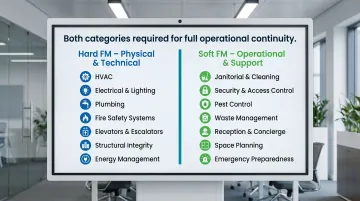
Core hard FM services include:
- HVAC operation and preventive maintenance
- Electrical systems and lighting
- Plumbing and water systems
- Fire safety systems (alarms, sprinklers, suppression)
- Elevators and escalators
- Structural integrity (roof, foundation, exterior envelope)
- Energy management and building automation
Hard FM is highly regulated. OSHA standards, NFPA fire codes, ASME elevator safety requirements, and local building codes govern how these systems must be maintained and inspected. Non-compliance carries direct legal and safety consequences.
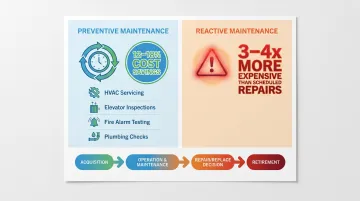
Hard FM failures are high-impact and visible. An HVAC breakdown in a midtown Manhattan office in July can immediately halt productivity and trigger emergency repair costs. According to the U.S. Department of Energy, a reactive repair costs 3 to 4 times more than the same repair performed on a preventive schedule.
Soft FM (Operational and Support Services)
Soft FM covers the people-facing services that make a space comfortable, clean, and functional for occupants.
Core soft FM services include:
- Janitorial and cleaning services
- Security and access control
- Pest control
- Waste management and recycling
- Reception or concierge services
- Space planning and interior reconfiguration
- Emergency preparedness and business continuity planning
Soft FM services are less likely to trigger a regulatory violation if missed once, but their cumulative effect on employee satisfaction, well-being, and brand perception adds up fast — particularly in client-facing office environments.
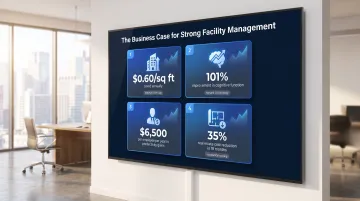
Harvard's COGfx study found that improved ventilation alone produces a 101% improvement in cognitive function scores, valued at approximately $6,500 per employee per year in productivity gains.
A clean, well-lit, temperature-controlled office is the product of multiple FM disciplines working in concert. When one breaks down, the entire occupant experience degrades — even services that seem minor compound quickly when the fundamentals aren't running.
Key Responsibilities in Commercial Facility Management
Facility management breaks into four functional areas — each with its own daily tasks and long-term strategic impact.
Operations and Preventive Maintenance
Preventive maintenance is the practice of scheduling inspections, servicing, and repairs before equipment fails, rather than waiting for breakdowns.
The DOE O&M Best Practices Guide finds that preventive maintenance delivers 12% to 18% cost savings over reactive approaches. Reactive repairs cost 3–4x more than the same repair done on schedule — making prevention straightforward to justify financially.
Core preventive activities:
- Scheduled HVAC filter changes and coil cleaning
- Quarterly elevator inspections
- Annual fire alarm testing and certification
- Monthly plumbing system checks
- Lighting audits and bulb replacement cycles
Space Planning and Asset Management
Space planning is the strategic process of designing and optimizing how a property's interior is used — workstations, conference rooms, common areas, circulation.
Real estate is the second-largest expense on most companies' balance sheets behind payroll. Underutilized space is wasted spend. Companies implementing occupancy tracking reduce real estate costs by an average of 35% within 18 months.
Asset management tracks the full lifecycle of physical equipment and infrastructure. Strong asset management means:
- Knowing when to repair versus replace major systems (chillers, elevators, electrical panels)
- Timing capital investments to avoid emergency failures
- Eliminating budget surprises through structured replacement planning
Compliance, Safety, and Risk Management
Facility managers ensure the building meets all applicable regulatory requirements:
- OSHA workplace safety standards
- ADA accessibility compliance
- Local fire codes and annual inspections
- Building permit and certificate of occupancy requirements
Documented compliance protects your business from liability exposure. For growing companies, this matters beyond the obvious — gaps in fire code or ADA compliance can surface during lease renewals, insurance audits, or due diligence reviews at precisely the wrong moment.
Vendor Coordination and Budget Management
FM teams or providers manage relationships with third-party contractors — plumbers, electricians, security firms, cleaning companies, landscapers — through service agreements.
Budget management involves:
- Operating cost control (recurring services)
- Capital planning (equipment replacement cycles, upgrade investments)
- Contract negotiation and vendor performance tracking
- Emergency repair fund allocation
Why It Matters: The Business Impact for Growing Companies
For high-growth companies scaling headcount quickly in competitive markets like New York City, the quality of facility management directly affects operations, productivity, and total cost of occupancy.
Real estate is the second-largest operating expense for most companies. Effective space management and preventive maintenance keep that number in check. ENERGY STAR data shows high-performing buildings save $0.60 per square foot annually on operations and maintenance versus typical buildings.
Harvard research shows enhanced ventilation improves cognitive function scores by 101%, delivering roughly $6,500 per person per year in productivity gains. The energy cost? Just $14 to $40 per person per year — a 150x return on investment.
Occupancy patterns add another layer of complexity. Partnership for New York City data shows 57% of Manhattan office workers are in the workplace on an average weekday, with 30% working a 3-day-per-week hybrid schedule. FM must optimize for variable occupancy, not static headcount.
That combination — cost pressure, productivity stakes, and fluctuating occupancy — is exactly why integrated management matters. For NYC companies navigating the full real estate lifecycle, Nomad Group handles facility management as part of a single coordinated service rather than leaving clients to stitch together multiple vendors. That means fewer handoffs and tighter coordination across brokerage, construction, and ongoing operations.
Facility Management vs. Property Management: What's the Difference?
Facility management and property management are frequently confused because they both involve commercial buildings — but they serve different stakeholders and pursue different goals.
Key distinctions:
| Dimension | Facility Management (FM) | Property Management (PM) |
|---|---|---|
| Primary focus | Occupant experience and building operations | Owner's financial return and asset value |
| Key question | Is the building safe, functional, and efficient for the people inside? | Is this property generating expected ROI for the owner? |
| Core responsibilities | HVAC/electrical/plumbing management, space planning, occupant services, maintenance | Lease negotiations, rent collection, tenant acquisition, financial reporting |
| Compliance priorities | OSHA, ADA, fire codes, building permits | Lease terms, landlord-tenant law, tax compliance |
| Value drivers | Uptime, energy efficiency, employee satisfaction | Occupancy rates, net operating income, cap rates |
Both roles converge around one outcome: tenant satisfaction. Property managers want lease renewals; facility managers create the day-to-day conditions that make tenants want to stay.
For companies leasing space, the distinction is practical. HVAC failure? That's an FM call. Lease renewal coming up? That's a property manager conversation.
Best Practices for Commercial Facility Management
Prioritize Preventive Over Reactive Maintenance
Establish scheduled inspection and maintenance programs for all critical building systems. Companies with mature preventive maintenance programs experience fewer emergencies, lower long-term repair costs, and more predictable operating budgets.
Leverage Technology for Visibility and Efficiency
Modern FM increasingly relies on purpose-built tools:
- CMMS (Computerized Maintenance Management System): Tracks maintenance tasks, work orders, and asset repair history
- IWMS (Integrated Workplace Management System): Broader platform covering space management, lease administration, compliance tracking, and energy management across a portfolio
JLL reports that 28% of organizations are actively embedding AI into FM operations, while 32% plan to increase FM software investment this year.
Partner with a Full-Service Provider
That shift toward software investment also raises a practical question: who manages the implementation? For companies that lack internal bandwidth to handle FM operations — particularly Series A–C companies and mid-market firms in NYC — the most effective approach is partnering with a full-service commercial real estate firm that integrates FM into the broader lease and operations lifecycle.
Nomad Group's Flex by Nomad model is built for exactly this scenario. Rather than standing up an in-house FM team or layering on a standalone outsourced vendor, companies get on-the-ground operational support — maintenance oversight, compliance tracking, vendor coordination — through Nomad's existing in-house infrastructure.
Frequently Asked Questions
What is commercial facility management?
Commercial facility management covers the ongoing oversight of a building's physical systems, services, and infrastructure. It spans maintenance, safety, compliance, space planning, and vendor coordination to keep the property operational and occupants productive.
What are facility management operations?
FM operations are the day-to-day tasks needed to keep a building running: scheduling maintenance, managing vendors, overseeing cleaning and security, ensuring systems like HVAC and electrical are functioning, and maintaining compliance with safety regulations.
What is an example of a hard FM?
HVAC maintenance is a core hard FM service, covering the regular inspection, servicing, and repair of heating, ventilation, and air conditioning systems. It's part of the building's fixed physical infrastructure and subject to safety code compliance.
What are the 4 P's of maintenance?
The 4 P's framework covers: People (the technicians and staff executing maintenance), Parts (the components and materials needed), Processes (the procedures and schedules followed), and Performance (the metrics used to evaluate maintenance effectiveness).
What is O&M in facility management?
O&M (Operations & Maintenance) covers the combined activities that keep a building's systems running. Operations handles day-to-day system functions like HVAC, electrical, and plumbing; maintenance handles the scheduled and corrective work to keep them reliable.
What is the difference between CMMS and FMS?
A CMMS (Computerized Maintenance Management System) focuses on tracking maintenance tasks, work orders, and asset repair history. An FMS (Facility Management System) or IWMS is broader, adding space management, lease administration, compliance tracking, and energy management.