TLDR:
- Integrated Facilities Management (IFM) consolidates all facility services—maintenance, cleaning, security, compliance—under one unified framework
- Companies typically reduce FM costs by 15-30% through vendor consolidation and preventive maintenance programs
- IFM delivers one contract, one platform, one point of accountability—eliminating fragmented vendor management
- Growing companies scaling to new locations or long-term leases benefit most from the integrated approach
- Technology platforms and strategic partnership quality matter more than price alone when selecting an IFM provider
What Is Integrated Facilities Management (IFM)?
Integrated Facilities Management consolidates all facility services—maintenance, cleaning, security, space management, compliance, and vendor coordination—under a single management framework or provider, rather than managing each function through separate contracts and teams. Instead of juggling multiple vendors for HVAC repairs, janitorial services, security personnel, and building compliance, companies using IFM work with one unified system that handles everything.
IFM can be delivered two ways:
- Outsourced model: A third-party provider manages all services on your behalf under one contract
- Internally unified model: All FM functions report to one team using a single technology platform
Both approaches share the same goal—eliminate silos, give leadership full visibility, and create clear accountability across every facility operation.
Technology underpins the IFM model. A centralized software platform—typically a CAFM or CMMS—provides real-time visibility into work orders, asset status, vendor performance, and spending across all locations. That data layer shifts facilities management from reactive problem-solving into long-term operational planning.
The evolution happened gradually. Facilities management emerged as an in-house function during the 1970s and 1980s, with the International Facility Management Association (IFMA) founded in 1980 to professionalize the discipline. By the 1990s and 2000s, companies began outsourcing individual services—one vendor for HVAC, another for cleaning, another for security—hoping to reduce costs.
That fragmented approach created its own problems: inconsistent service quality, duplicated effort, and no visibility across the portfolio. IFM emerged as the fix—consolidating those scattered contracts under unified oversight.
Today, the global IFM market is projected to grow from $175.84 billion in 2025 to $345.70 billion by 2034 at a 7.10% compound annual growth rate, according to Precedence Research. The broader facilities management industry is valued at $3 trillion with $800 billion+ in projected growth by 2030, per JLL's 2025 Global State of Facilities Management Report.
What IFM Is Not
IFM is not simply outsourcing your cleaning contract or hiring a building manager. It's the integration of all facility functions under unified oversight, spanning:
- Hard services: HVAC, electrical, plumbing
- Soft services: cleaning, security, reception
- Operational functions: space planning, vendor management, compliance
IFM also differs from Total Facilities Management (TFM), though the terms are often used interchangeably. TFM bundles all services under one contract. IFM goes a step further—integrating the underlying systems, data, and processes so those services actually work together, not just under the same invoice.
IFM vs. Traditional Facilities Management: Key Differences
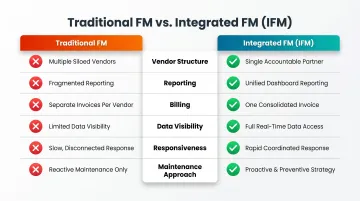
Traditional facilities management operates in silos. Companies typically manage separate vendors for HVAC maintenance, cleaning services, security personnel, IT infrastructure, and repairs. Each vendor has its own contract, invoicing system, and communication channel.
Different internal stakeholders oversee different categories—operations might manage HVAC, HR might handle cleaning, finance tracks invoices—and no single person has a complete picture.
This fragmentation carries real costs. A McKinsey case study documented a global financial institution spending $450 million annually across more than 10,000 vendors to maintain thousands of locations. By consolidating to one integrated vendor and standardizing processes, the organization reduced costs by over $150 million across three years—a savings rate exceeding 30%.
Fragmented FM also defaults to reactive maintenance because no single provider has visibility across all building systems. The U.S. Department of Energy's FEMP guide shows reactive maintenance costs $18 per horsepower per year versus $13 for preventive programs—a 12-18% cost penalty for waiting until equipment breaks.
IFM addresses this directly. All service streams operate under one contract and a single point of accountability, eliminating the coordination gaps that drive up costs. Communication flows through one channel, reporting consolidates into one dashboard, and strategic decisions rely on complete data rather than partial snapshots.
| Dimension | Traditional FM | Integrated FM (IFM) |
|---|---|---|
| Vendor structure | Multiple vendors per service category | Single provider or unified internal team |
| Reporting | Fragmented across vendors/departments | Centralized dashboard with real-time data |
| Billing | Multiple invoices, inconsistent formats | Consolidated billing, transparent cost tracking |
| Data visibility | Limited; each vendor owns their own data | Complete visibility across all services and sites |
| Responsiveness | Coordination delays across vendors | Single point of contact, faster resolution |
| Maintenance approach | Predominantly reactive (55%+ industry average) | Preventive and predictive (top performers run <10% reactive) |
Key Components of Integrated Facilities Management
Hard Services
Hard services cover the physical building systems that keep a property operational — and in most jurisdictions, legally compliant. These include:
- HVAC maintenance – scheduled inspections, filter changes, and seasonal calibration to maintain air quality and efficiency
- Electrical systems – power distribution, lighting controls, and backup/emergency system testing
- Plumbing – water supply, drainage maintenance, and fixture repairs
- Fire safety systems – alarm testing, sprinkler checks, suppression equipment servicing, and mandatory inspections
- Elevator maintenance – compliance-driven servicing schedules and emergency repair response
- Structural repairs – building envelope integrity, roof maintenance, and facade inspections
Hard services account for the majority of FM spending. Precedence Research reports that hard FM contributed 55% of market share in 2024, with soft services growing rapidly as workplace experience becomes a higher priority.
Soft Services
Where hard services maintain the building, soft services shape the day-to-day experience inside it. They directly affect how employees feel at work and how visitors perceive the space:
- Cleaning and janitorial – routine cleaning schedules, waste removal, and restroom upkeep that set baseline workplace standards
- Security personnel – access control management, front desk staffing, and 24/7 monitoring coordination
- Reception and front-of-house – visitor check-in workflows, mail handling, and first-impression management
- Landscaping – grounds maintenance and exterior presentation that support curb appeal and tenant pride
- Waste management – recycling program administration and compliant disposal coordination
Space and Workplace Management
For scaling companies, how space is allocated and used can be just as consequential as the physical condition of the building. IFM incorporates space strategy directly into day-to-day operations:
- Desk booking systems – hoteling and hybrid work coordination
- Move management – internal relocations, floor reconfigurations
- Occupancy planning – space utilization analysis, right-sizing decisions
Getting this component right reduces wasted square footage — a meaningful cost factor in markets like NYC, where office rent per square foot is among the highest in the country.
Vendor and Supplier Management
Fragmented vendor management is one of the biggest sources of operational inefficiency in multi-service facilities. IFM consolidates those relationships under a single program, creating accountability across the board:
- Vendor vetting and contracting
- SLA (service level agreement) oversight and enforcement
- Performance tracking and scorecarding
- Consolidated procurement for volume discounts
This centralization also eliminates the common problem of overlapping contracts and duplicated scope — where two vendors charge for the same service because no single owner is tracking the full picture.
Financial and Compliance Management
Beyond operations and vendor oversight, IFM brings financial discipline and regulatory accountability into the same framework:
- Unified budget planning and forecasting
- Centralized invoice processing and cost allocation
- Health and safety compliance tracking
- Environmental standards adherence
- Building code and local regulation management
For NYC commercial office tenants, this component is especially critical. Local Law 97 places annual carbon emission caps on buildings over 25,000 square feet, with penalties of $268 per metric ton of CO₂ exceeded. Approximately 57% of covered properties are projected to exceed their 2030 caps, making integrated compliance management essential.

Benefits of IFM for Growing Companies
Cost Efficiency
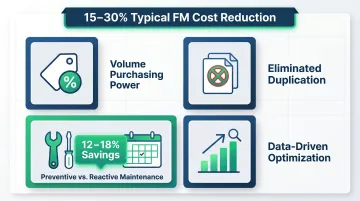
Consolidating contracts and eliminating duplication typically reduces overall FM spend significantly. The McKinsey report on FM sourcing trends documents a large retailer achieving a 15% reduction in FM spending through outsourcing, while the financial institution case study showed 30%+ savings through vendor consolidation.
Predictive maintenance programs deliver additional savings. The U.S. Department of Energy reports that organizations implementing preventive maintenance reduce costs by 12-18% compared to reactive approaches, while predictive maintenance delivers a 10x return on investment and a 70-75% elimination of equipment breakdowns.
Cost efficiency under IFM comes from:
- Volume purchasing power – single provider negotiates better rates
- Eliminated duplication – no redundant administrative overhead across vendors
- Preventive vs. reactive – scheduled maintenance costs less than emergency repairs
- Data-driven optimization – unified visibility enables smarter resource allocation
Operational Focus
When facility operations run through a unified system, leadership and staff redirect attention to core business functions. For fast-scaling companies where management bandwidth is the scarcest resource, that shift matters — teams spend less time chasing vendor issues and more time on product, hiring, and growth.
The IFMA/Simplar Foundation FM Pulse Report found that the average time to fill FM vacancies reached 3.7 months, with 37% of organizations increasing staff outsourcing in response. Talent scarcity makes the case for IFM stronger—companies that can't hire FM specialists internally benefit from outsourcing to integrated providers.
IFM also frees up time for leadership-level decisions that actually move the business forward:
- Hiring and team structure
- Product roadmap and go-to-market priorities
- Client relationships and revenue growth
Scalability and Adaptability
As companies grow, downsize, or reconfigure space, an IFM framework scales with them. Adding a new location under an existing IFM contract introduces marginal complexity to a system already designed for multi-site visibility — rather than triggering a new round of vendor procurement.
That scalability holds at any size. CBRE's IFM offering operates across 130+ countries with a "global-to-local service delivery approach," illustrating how integrated frameworks support geographic expansion without sacrificing consistency. The firm describes its model as ensuring "agility, scalability and continuous improvement" by shifting from transactional to performance-based contracts.
Signs Your Company Needs IFM
Operational Signals
If facilities issues regularly disrupt work, vendors are inconsistent or hard to coordinate, and internal staff spend disproportionate time managing service providers instead of their actual roles, these are operational red flags. You've outgrown ad-hoc FM management.
Additional warning signs include:
- Delayed response times when issues arise
- Inconsistent service quality across floors or sites
- Difficulty finding the right contact when something breaks
- Work orders falling through cracks between vendors
Financial Signals
When FM costs feel unpredictable, invoices are hard to reconcile across departments, or emergency repairs consistently deplete the budget, you lack integrated oversight. Fragmented FM makes it impossible to forecast spending accurately or identify cost-saving opportunities.
That cost pressure is widespread. JLL's 2025 report found that 84% of CRE and FM leaders cite budget constraints and escalating costs as a top concern, while 81% prioritize cost efficiency and budget optimization as a leading priority.
Growth Signals
Companies preparing to expand into larger office space, opening a second location, or transitioning from flexible shared space to a dedicated long-term lease are at the ideal inflection point to implement IFM.
For high-growth companies navigating NYC's commercial real estate market, this is where having one partner manage the full picture matters most. Nomad Group's facilities management service covers that end-to-end need, from lease negotiation through buildout and ongoing operations, so scaling teams aren't juggling multiple vendors during a critical transition.
How to Choose the Right IFM Partner
Define Evaluation Criteria
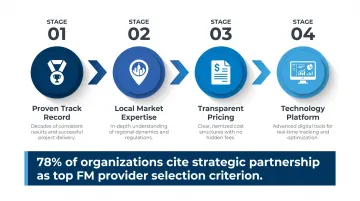
The right IFM provider checks several non-negotiable boxes:
- Proven track record across the specific services you need
- Deep knowledge of your local market and regulatory environment
- Transparent pricing with no hidden costs or hourly surge fees
- Demonstrated response times that match your operational demands
In a complex market like NYC, where Local Law 97 compliance, building code requirements, and rapid response times matter, local expertise is not optional.
JLL's 2025 State of FM Report found that 78% of organizations cite strategic partnership with a deep understanding of their core business as the top selection criterion for an FM provider, emphasizing FM's elevated role as an integrated advisor.
Don't fall into the trap of selecting based on price alone. The RICS/IFMA Strategic FM Framework warns: "Outsourcing which relies on cost savings created by driving down staff numbers or wage rates tends to create a high level of risk, since there is likely to be an immediate impact on staff expertise, motivation, numbers and resilience."
Assess Technology and Reporting Capabilities
Your IFM partner should offer a technology platform that gives you real-time visibility into work orders, spend, vendor performance, and asset condition—not just monthly PDF reports. 28% of organizations have already embedded AI in FM operations (rising to 46% for large enterprises), and 92% have piloted or plan to pilot AI tools, according to JLL's 2025 research.
The relevant question is no longer "Do you have a CMMS?" It's "How does your data platform integrate across hard and soft services, multiple locations, and your building's compliance reporting requirements?"
Look for a Consultative, Relationship-Driven Approach
The best IFM partnerships go beyond service delivery. A strong partner acts as a strategic advisor, helping you anticipate facility needs as headcount grows or leases come up for renewal, not just responding to issues after they surface.
Nomad Group's facilities management service is built on this relationship-first model, offering NYC office tenants a full-service partner who understands both the real estate and operational dimensions of running a scaling company's workspace. With deep expertise across NYC's core commercial neighborhoods (Flatiron, NoMad, Union Square, SoHo, Williamsburg) and a portfolio of 300+ tenant buildouts and 2 million+ square feet under management, Nomad Group brings local market knowledge and operational execution together to support companies as they grow.
Frequently Asked Questions
What is the meaning of integrated facilities management?
Integrated Facilities Management consolidates all facility services—maintenance, cleaning, security, compliance—under a single management system or provider to improve efficiency and reduce operational complexity. It replaces fragmented vendor relationships with a single point of oversight.
What is the difference between facilities management and integrated facilities management?
Traditional FM manages services in silos with separate vendors for each function. Integrated FM unifies all those services under one framework, one contract, and one point of accountability for streamlined oversight and better data visibility.
What are integrated facility management services?
IFM services span the full scope of building and workplace operations:
- Hard services: HVAC, electrical, plumbing, fire safety
- Soft services: cleaning, security, reception, landscaping
- Workplace management: space planning and utilization
- Vendor coordination and financial/compliance oversight
All are managed through a unified platform.
What are the 4 pillars of facility management?
The four pillars—people, place, process, and technology—represent a widely used industry framework (though not an official IFMA standard). IFM brings all four together so workforce management, physical space, operational processes, and technology systems operate as one cohesive unit rather than in isolation.
What is facility management support?
FM support is the operational backbone that keeps a physical workspace functional and compliant. It covers routine maintenance, cleaning, emergency repairs, space planning, and regulatory adherence to sustain a safe, productive environment.
What are examples of facilities?
In commercial contexts, facilities include office buildings, multi-tenant commercial properties, data centers, and any physical space a company uses to conduct operations. Each requires coordinated management across building systems, safety, and service delivery.