According to McKinsey's analysis of over 16,000 projects, only 8.5% met their cost and schedule targets. For companies facing hard lease commencement dates and limited capital runway, these statistics underscore why professional construction management isn't optional — it's essential.
This guide covers what commercial construction management is, how it differs from general contracting, the seven stages of a project lifecycle, and what to look for in a construction management partner. Whether you're planning your first office buildout or your fifth expansion, understanding these fundamentals will help you make smarter decisions and avoid costly missteps.
TLDR:
- Commercial construction management oversees all project phases from pre-design through closeout, prioritizing on-time, on-budget delivery
- A construction manager represents the owner's interests with full cost transparency, while a general contractor executes under a lump-sum bid
- Projects move through seven stages: development, design, pre-construction, procurement, construction, commissioning, and closeout
- NYC permit timelines average 79 days but can extend beyond 11 months, making early CM involvement critical for schedule protection
- 78% of construction firms report project delays, with labor shortages, material lead times, and permitting delays as top causes
What Is Commercial Construction Management?
Commercial construction management (CCM or CM) is defined by the Construction Management Association of America (CMAA) as "a professional service that provides a project's owner(s) with effective management of the project's schedule, cost, quality, safety, scope, and function." Unlike general contracting, which focuses on executing construction work, CM is a management discipline applied across all project phases — from initial planning through final handover.
The scope of commercial construction includes offices, retail spaces, restaurants, medical facilities, hotels, and industrial buildings — any structure built primarily for business or institutional use rather than residential living. These projects typically involve:
- Larger budgets than residential builds
- More stakeholders (architects, engineers, landlords, local agencies)
- Stricter regulatory requirements and permitting processes
- Complex mechanical, electrical, and plumbing (MEP) systems
Commercial construction management principles apply just as directly to tenant buildouts and office renovations as they do to large-scale infrastructure projects. For scaling companies securing new space, this is where CM matters most.
Whether you're fitting out 3,500 square feet or 10,000 square feet, the same core disciplines apply:
- Planning and scope definition
- Contractor coordination
- Cost control and budget tracking
- Quality assurance
- Stakeholder communication
CMAA emphasizes that the construction manager's "responsibility is to the owner and to a successful project," distinguishing the role from both architect and contractor. In practice, that means the CM's incentives align with yours — keeping the project on schedule, on budget, and built to spec — not with the contractor's margin or the architect's design preferences.
Commercial Construction Manager vs. General Contractor: Key Differences
Understanding the structural difference between a construction manager and a general contractor is critical when selecting your project delivery approach.
Representation and Incentives
A construction manager acts as an extension of the owner or tenant, representing their interests throughout the entire project lifecycle. The CM's mandate is to deliver the project on time, on budget, and to specification — outcomes that align directly with the owner's goals.
A general contractor, by contrast, is a vendor hired to execute the build. The AIA Contract Documents explanation clarifies that the GC "typically joins the project once the design is complete and the construction phase is ready to begin," focusing on execution rather than strategic planning.
The GC's primary incentive is completing the project efficiently to maximize their profit margin, which can create tension when owner interests and contractor profitability diverge.
Timing of Involvement
One of the most impactful differences is when each party joins the project:
- Construction Manager: Engages during pre-design or early design phases, providing input on feasibility, value engineering, and cost planning before drawings are finalized
- General Contractor: Enters after design completion when bid packages are issued, with no influence over design decisions that significantly affect cost and timeline
Early CM involvement enables proactive cost management and design optimization. Design-phase changes cost a fraction of what the same modifications cost mid-construction, when the owner has fewer alternatives and must absorb premium pricing.
Transparency and Compensation
The compensation structure shapes how each party operates — and whose interests they serve:
Construction Manager:
- Paid a fee (flat, hourly, or percentage-based)
- Passes all project costs through to the owner with full transparency
- No markup on subcontractor work or materials
- Earns the same fee whether the project costs $500,000 or $550,000
General Contractor:
- Submits a lump-sum bid that bundles all costs plus profit margin
- Provides limited visibility into actual costs
- Benefits financially from reducing scope or substituting cheaper materials, but absorbs cost overruns up to the contract amount and keeps any savings
Risk Allocation
In a CM-as-agent arrangement, the owner retains financial risk for cost overruns but gains maximum control and oversight. With a GC-at-risk model, the contractor absorbs overruns (up to the guaranteed maximum price), providing budget certainty at the cost of owner control.
A hybrid approach — Construction Manager at Risk (CMAR) — combines elements of both. The CM provides preconstruction services and cost transparency during design, then assumes financial obligation under a guaranteed maximum price (GMP) during construction.
Project Delivery Methods Overview
Different delivery models allocate risk and responsibility differently. Here's how the four primary approaches compare:
| Method | Who Holds Risk | Owner Control | Key Advantage |
|---|---|---|---|
| Design-Bid-Build (DBB) | General Contractor | Moderate | Well-established, competitive pricing |
| CM as Agent (CMa) | Owner | Maximum | Full cost transparency, no CM performance risk |
| CM at Risk (CMAR) | CM (under GMP) | High | Fast-tracking phases; early procurement of long-lead items |
| Design-Build (DB) | Single Entity | Lower | Single point of accountability |
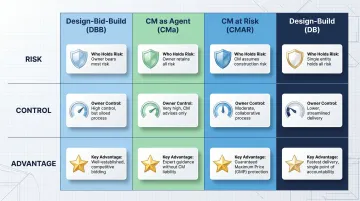
The AIA-AGC Primer on Project Delivery notes that CMAR's ability to overlap phases and enable "timely purchasing of critical materials and long-lead-time items" makes it particularly valuable in constrained supply markets.
The 7 Stages of a Commercial Construction Project
Commercial construction projects move through a predictable lifecycle. CMAA's framework organizes these phases around planning, design, procurement, construction, and commissioning — each with distinct deliverables and decision points.
Stages 1–3: Development, Design, and Pre-Construction
Stage 1: Development/Feasibility Site selection, feasibility studies, financial planning, and securing funding all happen here. For tenant buildouts, this means evaluating potential spaces, assessing landlord work letter contributions, and pinning down total project budgets — including tenant improvement allowances.
Stage 2: Design Architects and engineers create drawings, schematics, and structural plans. The CM conducts constructability reviews, value engineering, and milestone cost estimating during this phase. Design decisions carry the most weight on final costs — changes during design cost 10–50% of what those same changes cost during construction.
Stage 3: Pre-Construction Pre-construction sets the conditions for everything that follows:
- Securing permits and approvals from local authorities
- Finalizing specifications and bid packages
- Selecting and contracting with subcontractors
- Developing detailed project schedules
- Assembling the field management team
NYC permit timelines average 79 days but extend to 178 days at the 75th percentile and 344 days at the 90th percentile. For tenants with hard lease commencement dates, permitting delays can trigger rent obligations before the space is usable — making early CM involvement in permitting strategy essential.
Once pre-construction groundwork is complete, the project shifts into active execution.
Stages 4–5: Procurement and Construction
Stage 4: Procurement Awarding subcontractor contracts, sourcing materials and equipment, and managing lead times for custom components. 35% of construction firms cite longer material lead times as a cause of project delays, with HVAC systems, electrical panels, and custom millwork among the longest-lead items.
Stage 5: Construction The CM's day-to-day responsibilities during the build phase include:
- Daily site coordination and progress tracking
- Schedule adherence and critical path management
- Cost control and budget variance reporting
- RFI (Request for Information) responses and submittal reviews
- Quality inspections and workmanship verification
While the CM's role is most visible during construction, the effectiveness of this phase depends entirely on the groundwork laid during pre-construction. Poor bid packages, incomplete drawings, or delayed permitting cascade into construction delays and cost overruns.
Stages 6–7: Commissioning and Closeout
Stage 6: Commissioning/Owner Occupancy Testing and verifying that all building systems — HVAC, electrical, plumbing, fire safety — perform to specification. This phase overlaps with owner move-in coordination, furniture installation, and IT infrastructure setup.
Stage 7: Project Closeout Closeout wraps up the project with:
- Final walkthrough and punch list creation
- Completion of outstanding items
- Final inspections and certificate of occupancy
- Handover of warranties, manuals, and as-built drawings
- Final cost reconciliation and close-out documentation
Owners who skip thorough closeout documentation often discover the gap when a system fails two years later and no one can locate the warranty or original equipment specs — a fixable problem that becomes expensive through neglect.
Key Responsibilities of a Commercial Construction Manager
Planning and Cost Management
The CM develops detailed project budgets early in the process, breaking down hard costs (materials, labor, equipment) and soft costs (permits, insurance, professional fees, contingencies). They continuously track actual spending against projections, identifying variances and course-correcting before overruns take hold.
McKinsey's review of over 300 billion-dollar megaprojects found average cost overruns of approximately 80%. While tenant buildouts don't approach this scale, the underlying causes — poor planning, scope changes, and coordination failures — apply across project sizes. Professional cost management directly addresses these risks.
Effective CMs use value engineering to identify cost savings without compromising quality or functionality. This might involve:
- Specifying equivalent materials that meet performance requirements at lower cost
- Adjusting finish selections in low-visibility areas
- Phasing construction to align with cash flow
- Negotiating bulk purchasing for materials
Schedule and Resource Management
Schedule control starts with the critical path — the sequence of tasks that sets the project's minimum duration. The CM builds and maintains this master schedule, because any slip on a critical path activity pushes the finish date by the same amount. Staying ahead of those risks requires constant attention, not reactive firefighting.
78% of construction firms report at least one delayed project, with top causes including:
- Worker shortages (45% of firms)
- Longer material lead times (35%)
- Lack of government approvals or inspectors (34%)
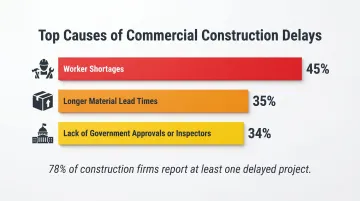
CMs address these challenges through early subcontractor engagement, strategic material procurement, and proactive permitting coordination. For tenant buildouts with lease commencement deadlines, schedule protection isn't just about convenience — it directly affects when rent obligations begin.
Quality Control and Compliance
Quality management extends throughout the build, not just at final inspection. The CM conducts regular site visits to verify:
- Work complies with approved drawings and specifications
- Materials match approved submittals
- Installation meets industry standards and building codes
- Subcontractor workmanship is acceptable
For NYC projects specifically, this includes navigating the Department of Buildings permit process, coordinating required inspections, and ensuring compliance with the city's building code, zoning regulations, and landmark preservation requirements.
Communication and Stakeholder Management
On any commercial buildout, the CM coordinates across a wide web of parties — owners, architects, engineers, contractors, landlords, and city agencies. Keeping everyone aligned requires structured protocols:
- Regular progress meetings with standardized agendas
- Weekly status reports with schedule and budget updates
- Centralized document management ensuring all parties work from current drawings
- Formal RFI and submittal tracking systems
- Structured change order review and approval workflows
CMAA's Owner's Guide notes that "well formulated and appropriately sized construction bid packages, developed during the planning and design process, are the key to minimizing changes and avoiding disputes and delays during construction."
That logic holds at every scale — from a 5,000 SF Flatiron buildout to a full-floor headquarters fit-out. Gaps in documentation don't stay gaps for long; they become change orders, delays, and disputes.
Common Challenges in Commercial Construction Projects
Regulatory Complexity and Permitting Delays
Commercial projects must navigate local, state, and federal regulations covering building codes, zoning, fire safety, accessibility, and environmental requirements. In NYC, this complexity intensifies due to the multi-agency review process.
Analysis of 45,000+ NYC building permits reveals median approval times of 79 days, but the distribution has a long tail — 25% of permits exceed 178 days and 10% exceed 344 days. Delays occur due to plan examiner objections, missing documentation, or required resubmissions.
For tenants, permitting delays create a cascade of problems:
- Lease rent obligations may begin regardless of construction status
- Employee relocation plans are disrupted
- Business operations remain in unsuitable temporary space
- Subcontractor schedules require renegotiation
Experienced CMs mitigate permitting risk through complete initial submissions, proactive communication with plan examiners, and strategic filing sequencing for complex projects.
Scope Creep and Change Order Management
Research from AIA Contract Documents analyzing 18,229 completed projects found average cost impacts from change orders of 4–5% across the project lifecycle. Commercial and retail projects represented the largest building-type category in the dataset at 20.53%.
The 4–5% average masks a critical dynamic: timing matters more than quantity. Change orders issued late in the project cost disproportionately more because the owner has fewer alternatives.
A design change during active construction means demolishing completed work, reordering materials, and renegotiating schedules — all at premium cost.
Common change order triggers include:
- Owner-initiated scope changes (upgraded finishes, layout modifications)
- Unforeseen site conditions (concealed infrastructure, structural issues)
- Product availability changes (specified materials discontinued)
- Updated code requirements during long project timelines
An experienced CM enforces a clear change order process before work proceeds:
- Documents the proposed change in writing
- Analyzes cost and schedule impacts
- Secures owner approval before proceeding
- Updates all project documentation accordingly
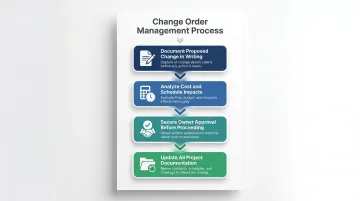
Without this process, cumulative changes that look like 4% overruns on paper routinely become 15% by project close.
Subcontractor Coordination and Labor Management
Large commercial projects involve multiple specialized trades working on overlapping schedules. Poor coordination creates work stacking (too many trades in one area), quality defects, and schedule delays.
Coordinating those trades is harder when the labor pool is shrinking. The AGC 2025 Workforce Survey reports:
- 88% of firms have open craft positions
- 83% report these positions are as hard or harder to fill than a year ago
- Electricians (77%), mechanics (79%), and iron workers (78%) are the hardest trades to find
- 48% report new hires fail to show up or quit shortly after starting
In NYC specifically, the construction workforce contracted from 254,900 to 247,000 workers in 2023, intensifying competition for qualified labor.
In this environment, CMs with established subcontractor networks hold a real advantage. Their coordination practices include:
- Pre-qualifying trades before project start
- Sequencing work to prevent trade conflicts
- Running regular coordination meetings
- Maintaining accountability through documentation and inspection
How to Choose the Right Commercial Construction Management Partner
Look for Relevant Experience in Your Project Type and Market
A CM's track record with similar projects — in terms of scale, building type, and geography — indicates their ability to navigate the specific challenges your project will face. In markets like NYC, local expertise matters:
- Knowledge of the Department of Buildings permit process
- Established relationships with reliable subcontractors
- Familiarity with landlord requirements and work letter negotiations
- Understanding of neighborhood-specific challenges (landmark districts, restricted access, noise ordinances)
Nomad Group's construction management team is a good example of what this looks like in practice: 300+ tenant buildouts completed across Manhattan, with a consistent 90-day turnaround for high-growth companies. That depth of NYC experience means they can anticipate DOB permitting timelines, work efficiently with landlords, and navigate the logistical realities of building in a dense urban market.

Evaluate Transparency and Communication Practices
A trustworthy CM provides complete visibility into project costs, schedule status, and emerging risks — not just high-level summaries. When evaluating prospective partners, ask:
- How do you handle change orders? What approval workflow do you use?
- How frequently do you provide progress updates, and in what format?
- What project management tools do you use for documentation and communication?
- Can I see examples of your standard cost reports and schedule updates?
Detailed documentation is the baseline — what it signals is whether your CM is genuinely representing your interests or just managing optics. If a prospective CM is reluctant to share cost breakdowns or progress data, treat that as a red flag worth taking seriously.
Assess Alignment of Incentives
Transparency in communication and transparency in compensation go hand in hand. Understand how your CM is paid and whether that structure actually aligns with your goal of delivering on time and on budget. Key questions include:
- Do you have an in-house construction team or manage a network of subcontractors?
- How do you select and vet subcontractors?
- Do you have any financial interest in recommending more expensive solutions?
- Is your fee structure fixed, or does it scale with project cost?
Fee structures that scale with project cost create a straightforward conflict: the CM earns more if the project costs more. Fixed-fee or hourly arrangements remove that conflict and keep both parties focused on cost control and efficiency.
Frequently Asked Questions
What is commercial construction management?
Commercial construction management is the discipline of planning, coordinating, and overseeing all phases of a commercial build — covering scheduling, budgeting, compliance, and contractor coordination — on behalf of the project owner. It applies professional management practices to ensure projects are delivered on time, within budget, and to specification.
What does a commercial construction manager do?
A commercial construction manager manages project budgets and schedules, coordinates subcontractors, ensures building code compliance, oversees quality control, and communicates project status to all stakeholders. They represent the owner's interests from pre-design through project closeout.
What's the difference between a general contractor (GC) and a construction manager (CM)?
A general contractor is a vendor hired to execute the build under a lump-sum bid, joining after design is complete. A construction manager represents the owner's interests throughout the entire project lifecycle — typically joining before design is finalized — and is compensated via a fee structure that prioritizes transparency over profit margin.
What are the 7 stages of a construction project?
The seven stages are: development/feasibility, design, pre-construction, procurement, construction, commissioning/owner occupancy, and project closeout.
Is CCM certification worth it?
The Certified Construction Manager (CCM) designation from CMAA is the industry's most recognized credential, requiring 48 months of responsible-in-charge experience plus passing a 175-question exam. Certified CMs demonstrate verified competence in schedule, cost, safety, quality, function, and scope management. For owners evaluating construction partners, it's a concrete indicator of professional accountability.