Introduction
Commercial office buildouts in competitive markets like New York City rarely go according to plan. A 2022 McKinsey study analyzing 532 capital projects found average cost overruns of 79% and schedule delays of 52%. Poor construction project management remains one of the leading reasons office buildouts run late and over budget — triggering lease penalties, delayed move-in dates, and costs that rival the buildout itself.
Construction project management covers every phase of a build — from initial design through final handover — to deliver a project on time, within budget, and to specification. For companies leasing and building out office space, this discipline addresses unique technical, regulatory, and multi-stakeholder challenges that don't arise in other project types.
Understanding where projects break down is the first step to preventing it. This guide covers the core stages of a commercial construction project, the key roles on your team, proven best practices to stay on schedule and on budget, common challenges specific to NYC tenant improvements, and when professional construction management becomes essential.
What Is Construction Project Management?
Construction project management is the practice of planning, coordinating, budgeting, and overseeing all phases of a build — delivering it on time, within budget, and to specified quality standards.
Unlike general project management, construction PM deals with a distinct set of technical demands:
- Building codes and permit approvals
- Safety protocols and site compliance
- Subcontractor scheduling and trade coordination
- Material procurement and lead times
- Multi-party sign-offs across owners, architects, engineers, contractors, and regulators
Construction Management vs. Project Management
These terms are used interchangeably, but they represent different scopes:
- Construction management focuses on field operations: daily site supervision, subcontractor scheduling, and trade coordination
- Project management operates at a strategic level, representing the owner's interests across the full lifecycle: budget oversight, contract administration, timeline enforcement, and stakeholder communication
For companies leasing office space in New York City, understanding which function you're hiring for — and whether your partner covers both — matters more than most tenants realize. A poorly managed buildout can delay your move-in date, trigger landlord penalties for missing a certificate of occupancy deadline, and ultimately cost more than the buildout itself. According to the Construction Industry Institute, rework alone accounts for 2-20% of total project cost, with most studies clustering at 4-10%. Miscommunication causes 26% of all rework; bad data causes another 22%.
The Financial Cost of Poor Management
A single moderately complex change order requires 8-15 hours of PM coordination time at $85-$120 per hour, costing $1,000-$1,800 per change order in untracked overhead. On a project with 15 changes, that totals $15,000-$27,000 in coordination costs alone — before the line-item costs of the changes themselves.
Extended general conditions from schedule delays cost $8,000-$15,000 per week for mid-sized projects, covering supervision, site facilities, and insurance. For tenant improvement projects with tight lease commencement deadlines, these delays compound quickly.
The Key Stages of a Commercial Construction Project
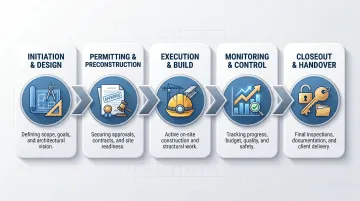
Stage 1 — Initiation and Design
This phase defines project scope, goals, and budget while selecting architects and engineers. The decisions made here determine what's achievable — and what isn't. Skipping thorough upfront planning is a leading cause of downstream delays.
Key activities include:
- Establishing space requirements and functional program
- Setting a realistic budget with appropriate contingency (typically 10-15% at this stage)
- Selecting your design team and establishing scope of work
- Conducting site surveys and base building assessments
- Defining project success criteria and delivery timeline
Stage 2 — Permitting and Preconstruction
This stage covers everything that must be locked in before a single wall goes up. In NYC, permitting timelines significantly affect overall project duration and must be factored into any realistic plan.
NYC Department of Buildings permit approval wait times increased 70.1% between June 2021 and June 2024, while DOB construction staff declined 21% during the same period. Industry estimates for DOB review timelines currently stand at:
- Alt-1 (standard filing): 3-4 months
- Alt-1 (self-certification): 3-4 weeks
- Alt-2 (standard filing): 4-6 weeks
Preconstruction activities include:
- Securing DOB permits and landlord approvals
- Finalizing contractor selection and pricing
- Procuring long-lead materials (HVAC equipment lead times currently run 20-52 weeks for some categories)
- Developing a detailed construction schedule with trade sequencing
- Establishing project communication protocols and approval processes
Stage 3 — Execution (The Build)
This is where general contractors and subcontractors carry out the physical work — MEP (mechanical, electrical, plumbing), carpentry, flooring, and finishes. This phase requires daily oversight to keep subcontractors coordinated and work progressing against schedule and budget baselines.
Touchplan's analysis of 321,000+ scheduled construction tasks identifies the top cause of delays: waiting for other disciplines. Subcontractor handoff problems ranked above staffing shortages, material delays, design changes, and weather combined.
Strong execution-phase management includes:
- Daily site supervision and subcontractor coordination
- Trade sequencing to prevent rework (for example, HVAC rough-in before drywall)
- Quality control inspections at critical milestones
- Material delivery tracking and job site logistics
- Safety compliance and building access coordination
Stage 4 — Monitoring and Control
Monitoring runs concurrently with execution — not after it. That means tracking cost against budget, comparing actual progress against the schedule, managing change orders, and maintaining documentation in real time. Without this discipline, cost overruns and schedule slippage go undetected until they're expensive to fix.
Critical monitoring activities:
- Weekly budget reviews comparing actuals to projections
- Schedule progress tracking with critical path analysis
- RFI (Request for Information) and submittal management
- Change order documentation and approval
- Meeting minutes and decision logs
Stage 5 — Closeout and Handover
Closeout covers final inspections, punch list resolution, regulatory sign-offs, and compilation of as-built drawings, warranties, and manuals. It's the phase most likely to get rushed — and the one tenants feel longest after move-in if it is.
Closeout deliverables should include:
- Final DOB and landlord inspections
- Punch list creation, tracking, and completion
- As-built drawings documenting all modifications
- Equipment warranties and operating manuals
- Final cost reconciliation and close-out documentation
Who's Who: Key Roles on a Construction Project Team
Understanding who does what prevents communication breakdowns and keeps your project moving.
Core team roles:
Project Owner (Client/Company): Commissions the space, approves budgets and changes, and ultimately occupies the finished buildout. Responsibilities: clear direction, timely approvals, and access to decision-makers.
Construction/Project Manager: Coordinates the full project lifecycle on the owner's behalf — covering contractor selection, schedule oversight, budget tracking, change order control, and stakeholder communication. The PM is your advocate.
General Contractor: Oversees day-to-day site operations and manages all subcontractors. Responsible for field execution: building to approved plans while meeting safety and quality standards.
Specialty Subcontractors: Execute specific trades — electrical, plumbing, HVAC, carpentry, flooring, painting. Each sub operates on a defined scope and schedule coordinated by the GC.
The PM-GC Relationship
Confusion between these roles is one of the most common sources of miscommunication on a project. The PM represents the owner's interests — keeping the project on time, on budget, and up to spec. The GC represents the contractor's side, focused on executing the work efficiently and profitably. Both are essential. Their priorities just don't always align, which is exactly why you need both clearly defined from day one.
NYC Building Coordination
On commercial tenant improvement projects, the construction manager works closely with the building's property management team and landlord to coordinate:
- Construction hours and after-hours access
- Loading dock and freight elevator reservations
- Building system tie-ins (HVAC, electrical, fire alarm)
- Compliance with building house rules and insurance requirements
Miss a loading dock reservation and you can lose an entire delivery day. This layer of coordination has no equivalent in ground-up construction — it's one reason office buildouts in NYC require a PM with direct landlord relationships.
Best Practices for Staying On Time and On Budget
Define Scope Thoroughly Before Breaking Ground
Scope creep is one of the most common reasons projects exceed budget. PMI's Pulse of the Profession found that 52% of all projects experience it — construction-specific data from Constrafor puts that figure at 75%, with an average 27% cost overrun.
A well-documented scope of work, reviewed and signed off by all parties before construction begins, creates a baseline that protects everyone. Your scope document should include:
- Detailed space plan with room-by-room finishes
- Equipment and fixture specifications
- Exclusions and assumptions
- Responsibilities matrix (who provides what)
- Approval and change order process
Build a Realistic Schedule with Contingency
A solid project schedule accounts for permitting delays, material lead times, and subcontractor availability. According to PMI research, schedule contingency typically runs 5–10% of total project duration for anticipated delays, with an additional 2–5% management reserve for truly unpredictable events.
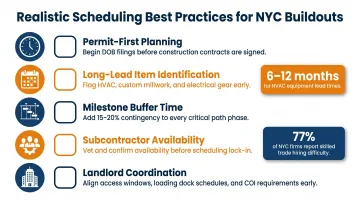
Best practices for realistic scheduling:
- Start with permit timelines — in NYC, assume 4-6 weeks minimum for Alt-2 filings
- Identify long-lead items early (HVAC equipment currently requires 6-12 months advance planning)
- Build in buffer time between critical milestones (typically 10-15%)
- Account for subcontractor availability — 77% of firms report difficulty filling positions
- Include landlord coordination time for building tie-ins and inspections
Establish Clear Communication Protocols
A locked schedule only holds if every stakeholder is working from the same information. Construction projects involve many parties — owner, PM, GC, architect, subs, and landlord — and ambiguous communication leads to rework, disputes, and delays.
Establish before work begins:
- Single point of contact for owner decisions
- Weekly project meetings with standing agenda
- RFI response timeline (typically 48-72 hours)
- Change order approval process with cost/schedule impact analysis
- Centralized documentation system (shared drive or project management platform)
Track Costs in Real Time, Not in Arrears
Clear communication keeps the schedule intact — but tracking money is what keeps the project solvent. Proactive budget management means comparing actuals to projections weekly, not monthly, so the PM can catch overruns before they spiral.
KPMG's 2023 survey found that 37% of respondents missed budget targets by 20%+ due to inadequate risk management. Separately, 83% said improving estimating accuracy is their top priority.
Real-time cost tracking should include:
- Weekly budget vs. actual reports by cost category
- Committed costs (approved purchase orders and subcontracts)
- Pending change orders with forecast impact
- Burn rate analysis to project final cost
- Shared dashboards providing client visibility
Manage Change Orders Formally
Changes to scope mid-project are inevitable but manageable when handled through a formal change order process. Every modification — whether driven by the client or by unforeseen conditions on site — should be documented, priced, and approved in writing before work proceeds.
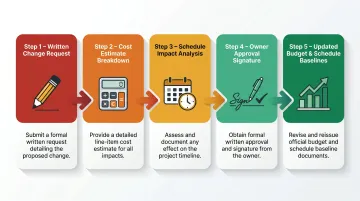
A structured change order process includes:
- Written change request with description and justification
- Cost estimate with labor, materials, and overhead breakdown
- Schedule impact analysis showing effect on completion date
- Owner approval signature before work begins
- Updated budget and schedule baselines reflecting approved change
Common Construction Project Management Challenges — and How to Solve Them
Every NYC office buildout faces predictable pressure points. Knowing them in advance — and having a response ready — is what separates projects that finish on time from those that don't.
Challenge 1 — Scope Creep
Undocumented client requests or design changes that accumulate without formal approval cause budgets to balloon and timelines to stretch. 85% of projects with scope creep exceed their budget, and 80% face schedule delays averaging 33%.
A documented change order process fixes this. Assign a PM who proactively flags the cost and schedule impact of every modification — no changes proceed without written approval and updated budget/schedule baselines.
Challenge 2 — Permitting Delays
NYC's building permit process can be unpredictable. Projects dependent on a single critical permit without contingency planning often stall. Permit approval wait times increased 8 days (70.1%) between 2021 and 2024 as DOB staffing declined 21%.
Plan for delays before they happen:
- File permits early — begin the process during design, not after
- Use self-certification where applicable to reduce review time
- Schedule pre-filing meetings with DOB examiners on complex projects
- Work with experienced local contractors who know the approval process
- Build permit wait time into your overall project schedule
Challenge 3 — Subcontractor Coordination and Sequencing
Commercial buildouts involve multiple trades working in tight timelines. Poor sequencing — such as drywall installation before HVAC rough-in is complete — creates costly rework. According to PlanRadar, 56% of companies with consistent QA/QC keep rework under 5% of budget, compared to just 37% without.
Tight sequencing requires active management:
- Develop a detailed project schedule with trade-by-trade sequencing
- Assign a superintendent to actively manage site coordination
- Hold weekly subcontractor coordination meetings
- Use a GC with strong subcontractor relationships and scheduling discipline
- Conduct pre-drywall MEP inspections before work is covered
Challenge 4 — Poor Documentation and Accountability
Poor record-keeping drives most disputes over scope, completions, and cost responsibility — and they're almost always avoidable.
Build an audit trail from day one:
- Maintain a daily site log documenting work performed, trades on site, and issues
- Track all RFIs and submittals in a centralized system with response dates
- Document all approvals in writing with timestamps
- Photograph conditions before, during, and after critical work
- A clear audit trail protects both owner and contractor when disagreements arise
When to Bring in a Professional Construction Management Partner
Key signals that indicate you need professional construction management:
- Lack of internal construction expertise: Your team knows your business, not buildouts
- Tight timelines: Lease commencement dates with financial penalties for delays
- First-time tenants: You've never managed a commercial buildout before
- Complex multi-trade scopes: Projects involving MEP upgrades, structural work, or extensive finishes
- High-growth companies: Leadership needs to stay focused on the business, not construction

The upfront cost of professional management is typically recouped through avoided delays and rework. A McGraw Hill Construction/CMAA Foundation study of 623 projects found that 84.9% of projects with Agency CMs finished on or under budget, versus 81.9% without. Schedule reliability improved from 65.9% to 68.8%, and only 16.2% of ACM projects attributed negative outcomes to ineffective management, versus 24.4% without.
That performance gap reflects what experienced CMs actually do on the ground. Here's what a full-service construction management partner brings to the table:
- Pre-vetted contractor relationships with known pricing and performance
- In-market experience navigating NYC permitting and landlord coordination
- Design coordination ensuring constructability and budget alignment
- Proactive cost oversight with real-time budget tracking
- Single point of accountability from design through delivery
Nomad Group's construction management service is built on 300+ completed tenant buildouts across NYC, with a proven 90-day turnaround model for qualifying projects. The team handles design coordination, permitting, contractor oversight, and delivery — all under one roof.
For high-growth companies, partnering with a firm that combines brokerage and construction management expertise frees leadership to focus on the business, not the buildout.
Frequently Asked Questions
What is project management in building construction?
Construction project management is the process of planning, coordinating, budgeting, and overseeing all phases of a build to deliver it on time, within budget, and to specified quality standards. It addresses the unique technical, regulatory, and multi-stakeholder demands of construction projects.
What are the 7 stages of a construction project?
The commonly cited stages are planning/design, pre-design, design, permitting, preconstruction, construction, and closeout. The exact count varies by framework, but every methodology follows the same core arc: from initial planning through execution to handover.
What does a commercial construction project manager do?
A commercial PM manages the full project lifecycle on behalf of the owner, including contractor selection, schedule management, budget oversight, change order control, and stakeholder communication. The PM represents the owner's interests to ensure the project meets timeline, budget, and quality expectations.
What is 90% of a project manager's job?
Communication — coordinating between stakeholders, documenting decisions, and managing expectations — constitutes the vast majority of a project manager's daily work. In practice, that means running meetings, responding to RFIs, and keeping every party aligned from groundbreak to closeout.
What are the 5 C's of project management?
The 5 C's framework includes Communication (clear information exchange), Collaboration (team coordination), Coordination (resource and task alignment), Control (monitoring and adjustments), and Closure (formal project completion).
What are the 4 types of project managers?
The four types are technical PM (engineering/systems focus), business PM (cost/schedule focus), operational PM (logistics/resources focus), and strategic PM (big-picture alignment). In construction, most PMs blend technical and business capabilities to handle both field execution and financial performance.