Yet many founders default to the first available coworking membership without understanding how the choice of environment — coworking versus incubator versus accelerator — can accelerate or limit their trajectory. The workspace decision intersects directly with your ability to raise funding, recruit senior talent, and build the operational foundation for scale. This guide breaks down how startup coworking spaces and mentorship programs work in NYC, what to look for when evaluating options, and how to recognize when it's time to graduate to your own space.
Key Takeaways
- Coworking spaces offer flexible infrastructure and community — incubators and accelerators add mentorship, investor access, and structured programs
- Accelerators are a different tier: structured funding, cohort accountability, and demo days that open real doors
- The right NYC workspace directly impacts your access to capital, advisors, and talent pipelines
- Flatiron, NoMad, and SoHo concentrate VCs, accelerators, and complementary startups — being in the same building as your next investor isn't luck, it's geography
- Judge a space by its programming and community, not its per-desk rate
- Past 10-15 people, dedicated space stops being overhead and becomes a recruiting and culture asset
Coworking Spaces, Incubators, and Accelerators: The Key Differences
Coworking spaces offer shared infrastructure — desks, WiFi, meeting rooms, and community events — on a flexible, month-to-month membership basis. You pay for access, not equity. These spaces serve any stage, from solo founders validating ideas to growth-stage teams maintaining satellite offices.
Incubators provide longer-term support for early-stage companies still validating product-market fit. Programs typically run 1-5 years, offering workspace, mentorship, and workshops without mandatory equity stakes (though some take minimal equity). NYU Tandon Future Labs exemplifies this model: non-equity, 12-24 month programs focused on helping pre-revenue founders experiment and iterate.
Accelerators are intensive, cohort-based programs lasting 2-6 months. They require a working MVP and tested business model. In exchange for 5-10% equity, accelerators provide seed capital ($150K-$250K), structured mentorship, and investor access, culminating in a Demo Day pitch. Techstars and ERA (Entrepreneurs Roundtable Accelerator) represent this model in NYC — Techstars invests $220K for 5% equity, ERA invests $150K for 6%.
These three models aren't mutually exclusive. Many NYC coworking spaces blur the boundaries by hosting investor office hours, speaker series, and programming that rivals formal accelerators. The table below captures the core differences at a glance:
| Coworking Space | Incubator | Accelerator | |
|---|---|---|---|
| Duration | Month-to-month | 1–5 years | 2–6 months |
| Equity Required | None | None (usually) | 5–10% |
| Capital Provided | None | None | $150K–$250K |
| Stage Fit | Any stage | Pre-revenue / early | MVP + tested model |
| Structure | Flexible, self-directed | Light-touch, mentor-led | Intensive, cohort-based |
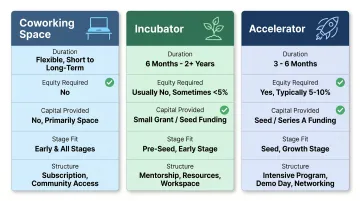
Your stage — not a prestige ranking — should drive which path you pursue.
What to Look for in a Startup Coworking Space in NYC
Community Quality Over Desk Price
The most underrated variable is who else occupies the space. Before signing, research the member composition: Are they in complementary industries? Does the space host curated events beyond happy hours? Does the culture match your growth ambitions? A cheaper desk surrounded by freelancers won't deliver the same network effects as a slightly pricier membership where your neighbors are Series A-funded SaaS founders and fintech operators.
Flexibility and Lease Terms
Early-stage startups rarely predict headcount six months out. Prioritize:
- Month-to-month membership options
- Ability to upgrade from hot desk to dedicated desk to private office within the same operator
- No long-term commitments before product-market fit
Manhattan hot desks run $300–600/month; Brooklyn operators like Green Desk offer hot desks from $150/month, roughly 50–75% less. Dedicated desks in Manhattan range $500–1,000/month versus $199–400 in Brooklyn.
Programming and Mentorship Access
Some NYC coworking spaces — particularly those affiliated with accelerators — offer:
- Office hours with investors
- Workshops on fundraising, hiring, and scaling
- Speaker series with operators who've built and exited companies
This structured programming signals that the space invests in member success, not just occupancy rates. For pre-revenue founders, that distinction matters as much as the desk price.
Location and Neighborhood Fit
Verify these before committing:
- Internet reliability (speed and redundancy)
- Conference room availability and booking process
- 24/7 access
- Phone booths for private calls
- Kitchen facilities and printing
NYC Mentorship Programs and Accelerators: What the Startup Ecosystem Offers
Overview of the NYC Accelerator Landscape
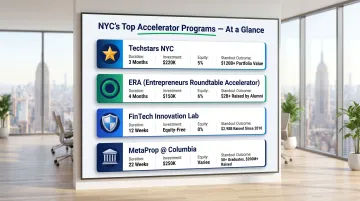
NYC's accelerator ecosystem spans general tech, fintech, health, hardware, media, and urban innovation. Key programs include:
Techstars NYC: 3-month program, $220K investment ($20K CEA + $200K uncapped Safe), 5% equity. Alumni portfolio valued at $120B+ with 21 unicorns.
ERA (Entrepreneurs Roundtable Accelerator): 4-month program, $150K on a 6% post-money SAFE. Alumni have raised $2B+ in capital with collective market cap exceeding $10B.
FinTech Innovation Lab: 12-week corporate-backed program with no equity requirement. 2025 class of 11 companies focused on agentic AI. Since 2010, graduates have raised $2.98B and created 3,000+ jobs.
MetaProp Accelerator at Columbia University: 22-week program for proptech and real estate tech startups, up to $250K financing, 50+ graduates who've raised $200M+ collectively.
Most programs culminate in Demo Day, where founders pitch to an audience of investors, corporate partners, and press.
University-Affiliated Programs
Cornell Tech Runway Startup Postdoc: For recent PhDs in digital technology. Year 1 package valued at $175K; year 2 at $150K (includes salary, research budget, housing allowance, office space on Roosevelt Island). 100+ startups launched with $660M total valuation.
NYU Tandon Future Labs: Network of non-equity incubators including Urban Future Lab (cleantech/climate), Data Future Lab, and Apex (9-month program for veteran founders). Typically 12-24 month incubation with subsidized workspace.
These programs offer deeper technical mentorship, lab access, and faculty networks — especially valuable for deep tech, AI, and hardware-adjacent startups.
What to Evaluate in a Mentorship Program
Beyond funding amount and equity stake, assess:
- Mentor quality and relevance: Domain expertise versus generalist advice
- Alumni network and outcomes: Track record of follow-on funding and exits
- Program management intensity: How hands-on is the team?
- Investor relationships: Does the program have genuine access to investors in your sector?
Look for mentors who've operated in your space, not just advised abstractly.
The Equity Question
Most NYC accelerators take 5-7% equity. Techstars takes 5% common stock plus a $200K uncapped Safe; ERA takes 6% via post-money SAFE. This dilution is real — but not inherently bad.
The right question isn't whether to give up equity — it's whether the network, lead check, and Demo Day access justify it. A well-connected accelerator can compress a 12-month fundraising timeline into weeks, which has real dollar value.
For dilution-sensitive founders, corporate-backed programs like FinTech Innovation Lab are worth prioritizing — structured support with no equity requirement.
Coworking + Accelerator Combinations
Some NYC spaces intentionally blend models. Participating in an accelerator while embedded in a strong coworking community multiplies mentorship access. Startups in the right spaces benefit from informal learning: hallway conversations, peer feedback, and pattern recognition that supplements formal programming.
Note: URBAN-X, a well-regarded urban tech accelerator based at Brooklyn Navy Yard's Newlab, is concluding operations at the end of 2025 due to strategic realignment by BMW Group. Before applying to any corporate-backed program, confirm the sponsor's multi-year commitment — funding cycles and strategic priorities shift, and program continuity is not guaranteed.
NYC's Best Startup Neighborhoods: Where You Work Shapes Who You Meet
The Flatiron/NoMad/Union Square Corridor
Often called "Silicon Alley," this stretch represents NYC's densest startup cluster. The concentration of VC firms, accelerators, law firms, and portfolio companies increases the probability of useful introductions. Office rents average $60-80/sf/year.
Nomad Group specializes in this corridor, with deep expertise in NoMad, Flatiron, and Union Square. The firm has completed 300+ tenant buildouts and leased 2M+ square feet across these neighborhoods, helping startups like Authentic Insurance and Extend transition from coworking to dedicated space.
SoHo and Lower Manhattan
Strong in creative tech, media, fashion tech, and consumer startups. SoHo office rents range $45-90/sf/year. Coworking spaces here attract design-forward founders and creative entrepreneurs. For startups in these verticals, proximity to relevant peers and potential collaborators is a real advantage.
Brooklyn (Williamsburg, DUMBO)
Brooklyn's startup scene has grown steadily, with rents running 30-45% below Manhattan (averaging $49-55/sf/year). Key hubs include:
- DUMBO: Design, tech, and urban innovation; home to Newlab at the Brooklyn Navy Yard (former home of URBAN-X)
- Williamsburg: Class-A options like The Refinery at Domino, with East River views and industrial-modern design
It's a strong fit for hardware, creative, or bootstrap-phase startups that want real community without Manhattan price tags. Nomad Group serves Williamsburg as well, helping startups like FloraFauna AI secure flexible, scalable space.
When to Move Beyond Coworking: Signs Your Startup Is Ready for Dedicated Office Space
Team Size Signals
Once your team consistently exceeds 10-15 people, coworking costs per desk often equal or exceed a small private lease — while you lose the ability to brand your space, control culture, or manage noise. The math shifts faster than most founders expect:
| Option | Cost Range | Notes |
|---|---|---|
| Manhattan private office (coworking) | $700–$1,800/person/month | No fit-out cost; flexible terms |
| 1,000 SF direct lease (5–10 people) | $5,000–$12,000/month | Requires upfront fit-out (~$149/sf avg.) |
| Crossover point | 8–10+ committed headcount | When direct lease becomes cost-competitive |
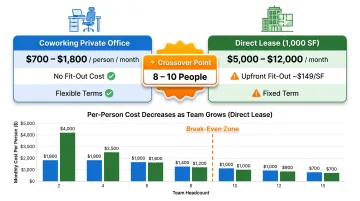
At 8-10 people consistently using the space, a direct lease typically wins on both cost and control.
Culture and Hiring
A dedicated, branded office becomes a recruiting tool. When you're trying to convince senior engineers, VP-level hires, or early enterprise customers that you're a real company, your own space with your brand on the door carries credibility that a generic coworking logo does not. Your office communicates seriousness, stability, and investment in culture.
Operational and Confidentiality Needs
Open coworking environments create real compliance and security exposure as startups scale. Common triggers include:
- Funding rounds — investor due diligence often surfaces data handling gaps
- HIPAA compliance — requires private offices, controlled acoustics, and secure storage
- SOC 2 audits — demand documented access controls and segregated digital systems
- IP-sensitive work — open floor plans are incompatible with trade secret protection
Any one of these is reason enough to start evaluating dedicated space.
Once you recognize these signals, the next challenge is executing the move without derailing operations. That's where having the right real estate partner matters.
How Nomad Group Helps Startups Make the Transition
Nomad Group works with high-growth NYC startups navigating the transition from coworking to their first dedicated lease. Services include:
Site Selection: Matching your headcount trajectory, culture needs, and budget to specific buildings across Flatiron, NoMad, Union Square, SoHo, and Williamsburg.
Lease Negotiation: Negotiating directly on the tenant's behalf — targeting improvement allowances, expansion rights, milestone-linked termination options, and sublease protections.
Buildout Management: Managing construction and design end-to-end. Nomad Group's typical turnaround is 90 days, backed by 300+ completed tenant buildouts.
Facilities and Operational Setup: Handling furniture procurement, IT infrastructure, cleaning, and ongoing space management so your team hits the ground running.
For example, Nomad Group helped Authentic Insurance transition from coworking to a dedicated full-floor office at 30 West 21st Street in Flatiron — negotiating a deal 30% under comparable coworking costs and delivering a branded space that scaled to 40 desks. For Extend, Nomad Group completed a full buildout from white-box to functional office in just five weeks, aligning the move with their Series A funding.
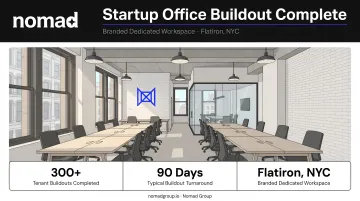
Both deals closed on time, within budget, and without disrupting day-to-day operations — which is exactly what the transition from coworking should look like.
Frequently Asked Questions
What is the difference between a startup incubator and an accelerator?
Incubators support early-stage idea validation over longer timeframes (1-5 years) with workspace, mentorship, and typically no mandatory equity stake. Accelerators are shorter, cohort-based programs (3-4 months) offering seed funding in exchange for equity (typically 5-10%) and ending with a Demo Day pitch to investors.
How much does a coworking space cost for a startup in NYC?
Manhattan hot desks run $300-600/month; dedicated desks $500-1,000/month; private offices $800-2,500+/month. Brooklyn operators like Green Desk offer hot desks from $150/month and dedicated desks from $199/month — a 50-75% discount. Programming quality, network density, and proximity to investors often matter as much as the monthly rate.
Which NYC neighborhoods are best for startups?
Flatiron/NoMad/Union Square is the densest startup cluster, concentrating VCs, accelerators, and law firms. SoHo is strong for creative and consumer tech. DUMBO and Williamsburg in Brooklyn offer 30-45% lower rents and growing ecosystems for hardware, design, and earlier-stage companies.
Can you get mentorship through a coworking space, or do you need an accelerator?
Some NYC coworking spaces — especially those affiliated with accelerators or incubators — offer investor office hours, speaker series, and programming. However, formal accelerator programs provide more structured, intensive mentorship with accountability and investor access that most coworking spaces cannot fully replicate.
When should a startup stop using a coworking space and get its own office?
Common signals include: team size consistently exceeding 10-15 people, coworking costs converging with a small lease, the need for a branded space for hiring and enterprise sales, or confidentiality/compliance requirements that make open environments impractical. At that inflection point, a tenant rep can help you move quickly without overpaying on your first direct lease.
Are NYC startup accelerators free, or do they take equity?
Most accelerators take 5-10% equity in exchange for seed funding ($150K-$250K) and programming access. Some corporate-backed programs like FinTech Innovation Lab offer support with minimal or no equity. Whether that trade-off makes sense depends on your current valuation and how much you'd actually use the network.