The concept of hiring a property manager is familiar, but how these companies actually operate — from contract signing to daily execution — is rarely explained in practice. This creates mismatched expectations, poor hiring decisions, and avoidable inefficiencies. This guide breaks down the full operational model of property management companies: what they do, how they work stage by stage, what they cost, and how to evaluate one.
TL;DR
- Property management companies handle the full lifecycle: tenant sourcing, lease management, rent collection, maintenance coordination, financial reporting, and legal compliance
- Operations follow three phases: onboarding, active management, and financial oversight — each with distinct responsibilities and deliverables
- Fee structures vary by property type: commercial management typically runs 3-4% of gross rent, while residential arrangements range from 8-12% of monthly rent
- The right management partner protects asset value, stabilizes income, and frees owners from day-to-day operations
What Is a Property Management Company?
Property management companies are professional third-party firms contracted to operate real estate assets on behalf of owners. They take responsibility for both routine and emergency tasks under the terms of a management agreement, handling the daily demands of running investment properties.
Why they exist: Property ownership and property operation require two distinct skill sets. According to the Institute of Real Estate Management (IREM), certified property managers collectively oversee $6.2 trillion in real estate assets, 29.4 million residential units, and 21.9 billion square feet of commercial space. These companies fill the operational gap for investors, developers, or organizations that own real estate but lack the time, staff, or expertise to run it day-to-day.
That scale reflects how broadly property management spans asset types. Four major categories cover most of the market:
- Residential — Single-family rentals, multifamily apartment complexes
- Commercial — Office buildings, retail centers, co-working spaces
- Industrial — Warehouses, distribution centers, storage facilities
- Special-purpose — Senior care facilities, schools, arenas, and other specialized assets
The operational model differs across these categories. Residential managers typically take a supervisory role overseeing multiple properties, while commercial property managers often handle direct operational control of large single buildings or portfolios. Lease structures, tenant relationships, and compliance requirements differ significantly across asset classes.
How Do Property Management Companies Operate?
Property management is not a single task but a continuous operational cycle. It runs from the initial setup of the management relationship through active daily operations and into ongoing financial oversight — each phase with defined responsibilities and decision-making boundaries.
Onboarding and Property Setup
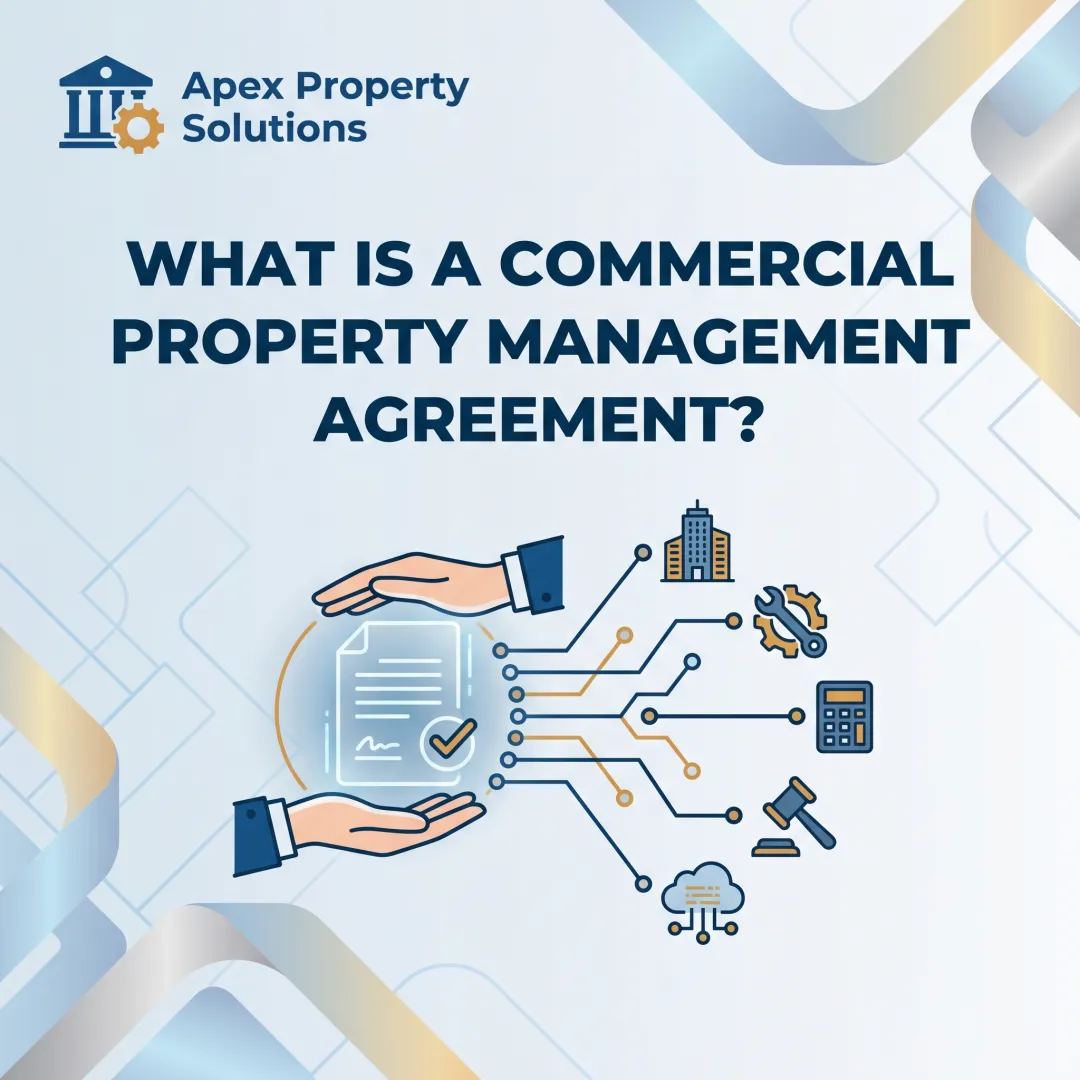
The engagement begins with a property management agreement that outlines scope of services, fee structure, authority limits, and communication protocols. This contract defines what the manager can handle autonomously versus what requires owner approval.
Standard agreement components include:
- Defines authority as general (broad) or limited designation
- Covers tenant procurement, lease execution, rent collection, maintenance coordination, and vendor supervision
- Sets repair expenditure thresholds — typically $300 to $1,500 — with separate emergency protocols
- Outlines compensation: base management fee (percentage or flat), leasing/renewal fees, and itemized add-ons
- Requires monthly financial statements, disbursement schedules, and reserve account reporting
- Specifies termination notice periods (commonly 30–90 days), early termination fees, and transition obligations
- Addresses E&O and liability insurance minimums, fair housing compliance, and dispute resolution
Source: National Property Management Authority
Setup phase deliverables:
- Property inspection and documentation of existing conditions
- Establishment of reserve accounts (typically 1-2 months of operating expenses)
- Setting market-based rent or lease rates
- Creation of tenant files or lease templates
- Vendor roster development and contract review
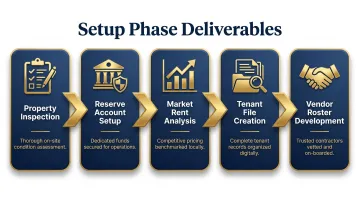
Once these steps are complete, operations begin on a defined baseline. For commercial properties, this phase also includes CAM reconciliation and tenant improvement coordination.
Day-to-Day Management
Active management covers tenant relations, maintenance operations, and regulatory compliance — each with its own workflows and accountability.
Tenant Management
The revenue cycle starts with vacancy marketing across multiple platforms, followed by applicant screening.
Under the Fair Credit Reporting Act (FCRA), property managers must comply with consumer report requirements when conducting background checks, which typically include:
- Credit characteristics and payment history
- Criminal background checks
- Employment and income verification (commonly 3x monthly rent)
- Prior rental history including eviction records
Managers execute leases, collect rent, enforce lease terms, and oversee renewals or terminations. LeadSimple/Harris Poll research shows that 36% of U.S. rental properties are now professionally managed, up from 30% in 2017 — representing approximately 1.3 million additional properties under third-party management.
Maintenance Operations
Property managers triage and assign work orders using either in-house staff or vendor networks. They conduct scheduled inspections, handle emergency repairs, and run preventive maintenance programs to avoid costly emergency repairs down the line. Established firms often secure preferred vendor pricing that individual owners cannot access.
Data from the 2026 Buildium/NARPM Industry Report reveals that maintenance responses exceeding 48 hours for non-emergencies are the primary driver for tenant non-renewal. Each turnover event costs landlords $2,000 to $5,000, with maintenance costs inflating 15-25% between 2022 and 2025.
Regulatory Buffer
Managers stand between owners and tenants on legal and compliance matters — handling disputes, issuing notices, managing eviction proceedings when necessary, and ensuring all actions comply with local landlord-tenant law and fair housing regulations. Princeton Eviction Lab data shows 1.23 million eviction cases were filed in 2025 across tracked sites, with an average filing rate of 7.9% (roughly 1 in 13 renter households).
Financial Oversight and Reporting
Property managers track all income and expenses, maintain reserve accounts, process vendor payments, and produce owner statements on a regular cycle. This provides owners full visibility without requiring involvement in day-to-day transactions.
Financial management includes:
- Rent/lease payment collection and accounting
- Operating expense tracking and categorization
- Reserve account maintenance (typically 1-2 months operating expenses)
- Vendor payment processing
- Monthly owner statements posted to web portals
- Capital expenditure approval requests above pre-agreed thresholds
The reporting cycle gives owners a clear picture of property performance without pulling them into daily decisions. Owners review statements, approve larger expenditures, and adjust the management agreement as the property's needs evolve — strategic oversight without operational burden.
What Do Property Management Operations Include?
The scope of services varies significantly by firm type and property class. Residential managers typically focus on tenant lifecycle and maintenance, while commercial operators extend their reach to include facilities management, compliance, asset strategy, and construction management.
Lease Administration (Commercial)
Commercial lease administration is far more complex than residential tenancy management. It involves managing multi-year lease agreements, rent escalation clauses (fixed/step increases, CPI-based adjustments, operating expense pass-throughs (meaning costs transferred directly to tenants)), and CAM reconciliations.
CAM reconciliation is an annual year-end process comparing estimated CAM charges billed throughout the year against actual common area expenses incurred. This requires detailed expense tracking and tenant-specific allocation calculations.
Facilities Management
Facilities management serves as the operational backbone for commercial properties. According to the International Facility Management Association (IFMA), facility management is a $1.1 trillion global industry with 25 million practitioners worldwide.
Core facilities functions include:
- HVAC, electrical, plumbing, and building systems management
- Security systems and emergency preparedness
- Janitorial and cleaning coordination
- Regulatory compliance and inspections
- Preventive maintenance programs
- Sustainability and ESG initiatives
Full-service commercial firms typically handle these functions in-house, assigning a single point of accountability across all building systems rather than coordinating between multiple outside vendors.
Financial and Compliance Services
Property managers handle the administrative and legal obligations that keep a building compliant and financially sound. Core responsibilities include:
- Property tax coordination and appeals support
- Insurance compliance verification for tenants and vendors
- Regulatory inspections and permit management
- Annual budget preparation and expense tracking
Technology Integration
PropTech adoption data shows that 78% of North American PropTech deployments were cloud-based in 2024, with over 70% of large U.S. commercial portfolios adopting some form of asset-management platform by 2025.
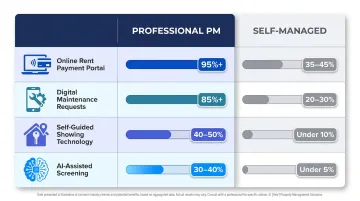
Technology adoption comparison (professional PM vs. self-managed):
| Technology | Professional PM | Self-Managed |
|---|---|---|
| Online rent payment portal | 95%+ | 35-45% |
| Digital maintenance requests | 85%+ | 20-30% |
| Self-guided showing technology | 40-50% | <10% |
| AI-assisted screening | 30-40% | <5% |
The gap between professional and self-managed adoption reflects a real operational difference — firms managing large portfolios have both the budget and the need to build these systems out properly.
What Does It Cost to Hire a Property Management Company?
Fee structures vary by property type — and knowing the numbers helps you evaluate whether professional management pencils out for your situation.
Residential Fee Structures
Belong's 2025 research on residential property management fees shows:
| Fee Type | Typical Range |
|---|---|
| Management fee | 8–12% of monthly rent collected (national average 8.49%) |
| Flat-fee management | Approximately $300/month |
| Setup/onboarding fee | $200–$500 |
| Leasing/placement fee | 70–100% of one month's rent |
| Lease renewal fee | $500–$1,000 |
| Inspection fee | Approximately $110 per visit |
Total annual costs often exceed $5,000 per property when add-on fees are included.
Commercial Fee Structures
IREM/BOMA/NAA Income/Expense IQ 2023 data provides national benchmarks:
| Property Type | Management Fee | As % of Gross Rents |
|---|---|---|
| Office buildings | $0.74/sq ft | 3.62% |
| Multifamily | $603.29/unit | 2.95% |
| Industrial | $0.32/sq ft | 3.77% |
Commercial arrangements often involve custom service agreements that bundle multiple functions (brokerage, facilities, asset management) under a single fee structure.
Evaluating the Return on Management Fees
The real question isn't what management costs — it's what self-management costs you. Weigh the fee against:
- Owner time diverted from higher-value activities
- Gaps in leasing expertise and market knowledge
- Limited access to pre-negotiated vendor pricing
- Legal risk from compliance gaps or violations
- Extended vacancy from slower leasing cycles
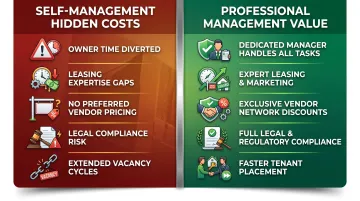
For investors managing multiple assets or operating in high-complexity markets, professional management often improves net return despite the added fee. Reduced vacancy cycles, institutional-grade vendor pricing, and compliance expertise frequently offset what you pay.
Conclusion
Property management companies operate as structured, stage-based partners that remove operational burden from owners while preserving and growing asset value. The model works because it separates ownership from operations, with both sides defined by clear contractual terms.
Owners who understand the operational model — from onboarding protocols to reporting cycles — can set better expectations, negotiate stronger agreements, and select partners who match their property type and long-term goals. That separation between ownership and operations is intentional — and when matched with the right firm, it's one of the most effective structures in real estate.
For commercial property owners in New York City, firms like Nomad Group provide brokerage, construction management, facilities management, and asset management under one team — reducing coordination friction and keeping accountability centralized across the full property lifecycle.
Frequently Asked Questions
What do property management operations include?
Operations cover the full property lifecycle: tenant management (sourcing, screening, leasing), maintenance coordination, rent/lease administration, financial reporting, and regulatory compliance. Commercial property management often extends to facilities management, CAM reconciliation, and asset strategy.
What does a property operations manager do?
A property operations manager oversees the day-to-day systems that keep a building or portfolio running: vendor management, maintenance schedules, tenant relations, and operational budgets. This role typically exists within a larger property management firm or in-house at a major commercial property owner.
What is the 2% rule in rental property?
The 2% rule is a screening benchmark suggesting a rental property may perform well if monthly rent equals at least 2% of its purchase price. It's primarily applied to residential investment analysis and should be one of several evaluation factors, not a standalone decision rule.
What are the 5 P's of property management?
The 5 P's framework (Plan, Process, People, Property, and Profit) is a conceptual model describing core pillars of well-run property management operations — covering strategic planning, systematic workflows, tenant/team management, physical asset upkeep, and financial outcomes.
What is the 3 3 3 rule in real estate?
The 3 3 3 rule is a financial readiness guideline sometimes cited with three checkpoints: 3 months of emergency savings, 3 months of payment reserves, and comparing at least 3 properties before purchasing. Apply it as a starting framework, not a definitive standard.