A commercial property management agreement creates the foundation that makes professional management possible. This legally binding contract defines exactly who does what, who pays for what, and who decides what — removing ambiguity before it becomes a costly dispute. This guide explains what these agreements are, what they must include, how fees are structured, and what NYC property owners should know before signing.
TLDR
- A commercial property management agreement is a legally binding contract defining roles, responsibilities, and compensation between property owners and management companies
- Core sections cover scope of services, authority thresholds, financial terms, insurance requirements, and termination conditions
- Management fees typically range from 4–10% of collected rents, with separate charges for leasing commissions and construction coordination
- Commercial agreements are significantly more complex than residential ones — longer leases, business tenants, and NYC regulations all add layers
- Before signing, review scope language with a real estate attorney to confirm terms match your property and ownership goals
What Is a Commercial Property Management Agreement?
A commercial property management agreement is a contract that spells out the relationship between the property owner and its manager, specifying the terms and conditions of financial and operational obligations for both parties. It's the legal framework that determines how your office building, retail center, or mixed-use property will be operated, maintained, reported on, and financially managed.
The agreement's core purpose isn't just to list tasks — it's to create accountability and remove ambiguity. When vacancy rates climb, when emergency repairs exceed budgets, or when tenant disputes arise, the agreement determines who is responsible and who has authority to act. Without clear language, these gray areas become expensive legal conflicts.
Property owners typically need formal management agreements in several situations:
- Owning multiple commercial properties across NYC
- Being a remote or out-of-state owner without daily on-site presence
- Lacking in-house property management expertise or staff
- Scaling a commercial real estate portfolio rapidly
- Navigating high vacancy rates or compliance challenges
The Two Key Parties
The agreement establishes a principal-agent relationship between two parties:
The property owner (also called the principal or landlord) retains legal ownership and ultimate decision-making authority over major capital decisions, financing, and disposition.
The property management company (acting as the owner's agent) is legally authorized to act on the owner's behalf within defined limits — handling tenant relations, vendor contracts, maintenance coordination, and day-to-day operations.
In practice, the management company role can be filled by a firm that handles far more than operations. Nomad Group, for example, covers the full property lifecycle — leasing, buildout, asset management, and facilities operations — so owners work with one partner instead of coordinating separate brokerage, construction, and operations vendors.
What Should Be Included in a Commercial Property Management Agreement?
Scope of Services and Responsibilities
This is the agreement's most detailed section, and vague scope language is one of the most common sources of disputes in property management. The scope defines exactly what the manager is and is not responsible for.
Common inclusions for commercial properties:
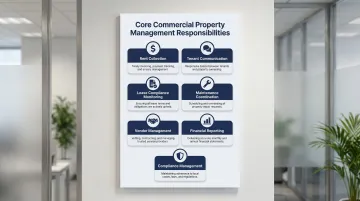
- Rent collection — collecting monthly rent, parking fees, storage income, and other tenant payments
- Tenant communication — serving as primary contact for tenant requests, complaints, and service issues
- Lease compliance monitoring — ensuring tenants adhere to lease terms, use restrictions, and operating covenants
- Maintenance coordination — scheduling preventative maintenance, coordinating repairs, managing common area upkeep
- Vendor management — selecting, contracting, and supervising cleaning services, HVAC contractors, elevator maintenance, and other service providers
- Financial reporting — preparing monthly income/expense statements, budget variance reports, and annual financial summaries
- Compliance management — ensuring the property meets OSHA requirements, environmental regulations, fire safety standards, and ADA accessibility rules
Excluded duties matter just as much. Without clear language defining what services will NOT be performed — such as major capital improvements, refinancing support, or extensive remodeling — expectations between owner and manager misalign. Many agreements fail to distinguish between services performed under any circumstance versus those undertaken only during emergency situations, creating dispute risk when emergencies arise.
Authority and Decision-Making Thresholds
The agreement must define spending limits — the maximum dollar amount the manager can authorize for repairs or vendor contracts without owner approval. This threshold creates a critical balance: set it too low and the manager constantly seeks approval for routine items like replacing a water heater; set it too high and owners lose visibility into capital decisions.
That balance point matters in practice.
Standard commercial agreements often set thresholds around $25,000 for capital expenditures, requiring written owner authorization for any unbudgeted capital item above that amount. Contracts typically require at least three written estimates for any capital project expected to exceed this threshold.
Emergency repair protocols should be separately addressed. Agreements should explicitly define:
- What constitutes an "emergency" (for example, water main breaks, HVAC failures during extreme weather, elevator malfunctions)
- The manager's emergency spending authority
- How quickly the manager must notify the owner
- Post-emergency reporting and documentation requirements
Many agreements also require owners to maintain a working capital reserve — often $50,000 or more depending on property size — in a dedicated Property Bank Account to fund emergency repairs and routine operating expenses without delay.
Legal Protections and Indemnification
Mutual indemnification clauses define each party's responsibility for certain liabilities depending on the circumstances. If the management company's negligence causes harm — for example, failing to repair a known hazard that injures a tenant — the management company assumes responsibility.
Conversely, if the owner makes a decision that creates liability (such as directing the manager not to make a legally required repair), the owner assumes that risk.
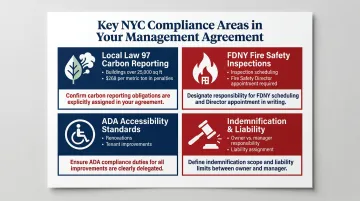
Liability language should be reviewed carefully by a real estate attorney, especially in states like New York where commercial property regulations are extensive. NYC-specific compliance requirements — including Local Law 97 carbon emissions limits, FDNY fire safety mandates, and ADA accessibility standards — create significant financial exposure if compliance responsibilities aren't clearly assigned.
Term, Renewal, and Termination Conditions
Commercial property management agreements typically include:
- Initial term — commonly one year, after which the agreement may become month-to-month or automatically renew
- Automatic renewal provisions — many agreements renew automatically unless either party provides advance written notice
- Termination notice periods — typically 30 to 90 days depending on the party terminating and whether termination is with or without cause
- Termination for cause — immediate termination rights if gross negligence, willful misconduct, business suspension, or uncured material default occurs
- Cure periods — typically 30 days to remedy a material default after written notice
- Post-termination obligations — requirements for final accounting, delivery of records, return of keys, and transfer of vendor contracts
Insurance Requirements
Standard agreements require both parties to maintain specific insurance coverage:
Management company requirements:
- General liability insurance
- Workers' compensation (statutory limits)
- Errors and omissions (E&O) insurance
- Fidelity bond/crime insurance to protect against employee theft
- Automobile liability if company vehicles are used
Property owner requirements:
- Commercial property insurance covering the building and improvements
- General liability coverage for the property
The management company is typically named as an additional insured on the owner's general liability policy, providing coverage for claims arising from the manager's operations on behalf of the owner. Both parties should exchange certificates of insurance before the agreement takes effect.
How Are Commercial Property Management Fees Structured?
Base Management Fees
Commercial property management fees typically range from 4% to 10% of gross rents collected, varying significantly by property type:
- Office buildings (full-service leases): 6-10%
- Retail properties: 5-8%
- Industrial/warehouse (NNN leases): 4-6%
- Mixed-use properties: 6-9%
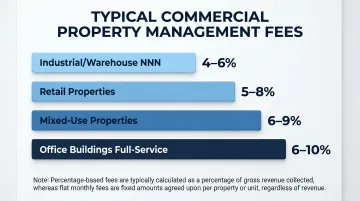
The percentage model aligns the manager's compensation with property performance: as rents increase, so does the management fee. Alternatively, some agreements use a flat monthly management fee ranging from $300 to $2,000+ depending on property size and operational complexity.
Additional Fee Categories
On top of the base management fee, commercial agreements often include:
Leasing commissions:
- New tenant placement: 25-100% of the first month's rent
- Lease renewals: 25-50% of one month's rent
Construction/project coordination fees:
- Typically structured as a percentage of total hard costs
- Common ranges: 5-8% depending on project size
- Covers manager's time overseeing contractors, reviewing plans, coordinating inspections
Special service fees:
- Setup/onboarding fees when management begins
- CAM reconciliation fees ($150-$500 annually)
- Eviction coordination ($300-$1,000 plus attorney costs)
- Insurance claim management fees
- Court appearance fees
Management Fees vs. Reimbursable Expenses
The management fee covers the manager's time and overhead — that's it. Owners remain responsible for funding actual operating expenses:
- Utilities (electric, gas, water, sewer)
- Property insurance and taxes
- Maintenance and repair costs
- Vendor contracts (cleaning, security, landscaping)
- Capital improvements and replacements
These costs flow through a separate minimum operating account, typically funded by the owner at $50,000 or more for commercial properties. That reserve ensures sufficient liquidity for routine expenses and emergency repairs without processing delays.
How Commercial Property Management Agreements Differ from Residential Agreements
Commercial property management agreements are meaningfully more complex than residential contracts. Three structural differences drive most of that gap:
Longer Lease Terms and Higher Stakes
Commercial tenants typically sign multi-year leases (often 3-10 years) compared to the standard residential one-year term. A single leasing mistake or tenant default can cost hundreds of thousands of dollars.
That financial exposure changes how authority is structured. Most commercial agreements require owner written approval for all lease executions — managers rarely sign on the owner's behalf without it.
Property Type Drives Operational Complexity
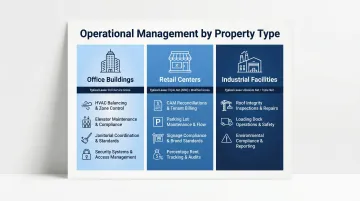
An office building in NoMad has fundamentally different operational demands than a retail center in SoHo or an industrial facility in Williamsburg:
- Office buildings: Managers cover all "building standard" systems and common areas — HVAC balancing, elevators, janitorial, and security. Tenants handle their own non-standard finishes and equipment.
- Retail centers: Managers run CAM reconciliations, parking maintenance, signage compliance, and percentage rent calculations. Tenant interiors are typically the tenant's responsibility.
- Industrial facilities: NNN lease structures shift most day-to-day operations to tenants. Managers focus on roof integrity, loading docks, and environmental compliance (Phase I/II assessments).
Enhanced Financial Reporting Requirements
Commercial property financial reporting goes well beyond what residential owners require. Owners typically need:
- Detailed monthly income/expense statements broken down by property and tenant
- CAM reconciliations showing actual vs. budgeted common area expenses
- Year-end reports suitable for CPA review and tax filing
- Records retained for up to seven years for potential tax audits or legal disputes
These reporting requirements should be explicitly defined in the agreement, including delivery deadlines, format specifications, and documentation standards.
Tips for Reviewing and Negotiating Your Commercial Property Management Agreement
Don't Rely Solely on Templates
Templates are a starting point, not a finished solution. Commercial properties in NYC carry specific operational, regulatory, and tenant dynamics that generic language won't address. A retail property in SoHo faces different compliance requirements than a Class A office tower in Grand Central. Each clause should reflect:
- Your actual property type and physical configuration
- Your current tenant mix and lease structures
- Your ownership goals (hold long-term vs. prepare for sale)
- Your risk tolerance and preferred decision-making style
Work with a Real Estate Attorney
Business owners should never sign without a qualified real estate contract lawyer reviewing every detail, especially for commercial and investment properties. An attorney familiar with NYC commercial real estate should review or co-draft the agreement, paying particular attention to:
- Indemnification clauses: Confirm liability allocation is reasonable and insurable
- Termination provisions: Verify notice periods are adequate and termination fees aren't punitive
- NYC compliance assignments: Spell out who is responsible for Local Law 97 carbon emissions reporting (buildings over 25,000 sq ft face penalties of $268 per metric ton over the limit beginning 2024), FDNY fire safety inspections, Fire Safety Director appointments, and ADA standards for renovations or tenant improvements
Plan for the Relationship to Evolve
Schedule periodic agreement reviews — at least annually — as circumstances change:
- When your building's tenant mix shifts significantly
- When your ownership goals evolve (from cash flow focus to value-add improvements)
- When new regulations emerge requiring compliance adjustments
- When property performance (vacancy rates, operating expense ratios) changes materially
Nomad Group builds this flexibility into every client engagement. Whether a portfolio is expanding and requires scaled facilities management, or market conditions shift and asset management priorities need to change, the agreement structure should support that evolution — not work against it.
Frequently Asked Questions
What should be included in a commercial property management agreement?
A solid commercial property management agreement covers six core areas:
- Scope of services — what the manager will and won't handle
- Financial terms — base fee structure and any additional charges
- Authority thresholds — spending limits that require owner approval
- Legal protections — indemnification and liability allocation
- Insurance requirements — coverage obligations for both parties
- Term and termination — notice periods and exit conditions
What are examples of commercial agreements in property management?
Common types include full-service management agreements (covering leasing, operations, maintenance, and financial reporting), leasing-only agreements (focused solely on tenant placement and lease negotiation), and asset management agreements (strategic oversight with day-to-day operations handled by others or in-house staff).
Can I pay myself a management fee for my rental property?
Yes, in certain ownership structures you can designate a management fee as a deductible business expense — IRS Publication 527 lists management fees as deductible rental expenses. Consult a CPA to confirm proper documentation and whether self-employment tax applies if you're paying fees to your own entity.
How much do commercial property managers typically charge?
Management fees for commercial properties typically range from 4-10% of collected rents, with office buildings at the higher end (6-10%) and industrial/NNN properties at the lower end (4-6%). Additional fees apply for leasing commissions (25-100% of first month's rent for new tenants), construction oversight (5-8% of project costs), and special services.
How do you terminate a commercial property management agreement?
Most agreements require written notice 30-90 days in advance, depending on whether termination is with or without cause. Some contracts include termination fees or obligate the departing manager to support a transition period.