
Construction management firms that specialize in office tenant work operate differently from general contractors — they advocate for the tenant's interests across every phase, from design coordination through final delivery. In NYC's regulatory environment, that distinction isn't subtle. It's the difference between a 90-day turnaround and a 6-month headache.
This article covers the top construction management firms serving NYC office tenants, plus the criteria that should guide your selection.
TL;DR
- Construction managers are tenant advocates: they own budget, schedule, permitting, and subcontractor coordination
- NYC-specific factors (DOB filings, union labor mandates, landmark constraints) make local experience non-negotiable
- Building costs are 33% above 2019 levels — the right CM protects your budget from the start
- Firms that combine CM with leasing close the gap between lease signing and buildout kickoff
- Prioritize NYC office interior track record over national revenue rank or brand recognition
What Is Construction Management for NYC Office Tenants?
CM vs. General Contractor: Why the Distinction Matters
The roles sound similar. They aren't.
General contractor: Enters after design is complete, holds subcontracts directly, and operates under a fixed-price model that prioritizes their own margin.
Construction manager: Works for the tenant — coordinating design, managing subcontractors, tracking budget and schedule, and representing your interests from day one.
In NYC, this distinction matters enormously. Without a dedicated CM, tenants often find themselves caught between a GC optimizing for their own interests and a landlord whose priorities don't fully align with yours.
NYC's Regulatory Layer
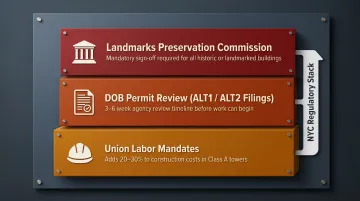
Standard office fit-outs in Manhattan typically fall under an Alteration Type 2 (ALT2) permit from the NYC Department of Buildings — covering work that doesn't change the building's use, egress, or occupancy. More complex renovations require an ALT1 filing. Either way, permit review typically takes 3–6 weeks before construction can begin, and landlord/DOB approvals combined can run 4–8 weeks.
Add to that:
- Union labor mandates in Class A towers, which add 20–30% to construction costs compared to non-union contractors
- Landmarks Preservation Commission (LPC) sign-off for historic or landmarked buildings
- Building management coordination for deliveries, elevator access, and after-hours work permissions
A CM who knows these variables in advance, and has working relationships with the relevant parties, can compress timelines significantly. One who doesn't can cost you months.
That's the lens used to evaluate every firm below — NYC office tenant track record, not national revenue or brand name recognition.
Top Construction Management Firms for NYC Office Tenants
These firms were evaluated on NYC office tenant specialization, project delivery history, regulatory fluency, and experience navigating NYC's building management environment. The right choice depends on your project size, timeline, and whether you need a firm embedded in the leasing process or brought in post-signing.
Nomad Group
Nomad Group is a full-service commercial real estate firm operating across Manhattan's core neighborhoods — Flatiron, NoMad, SoHo, Union Square, Bryant Park, and Williamsburg. With 300+ tenant buildouts completed and 2M+ square feet under management, Nomad has evolved well beyond brokerage to offer genuinely integrated construction management.
What sets Nomad apart is where their involvement starts: at the lease, not after it. Their construction and design teams engage during the leasing process, so tenants don't face the common gap between signing and buildout kickoff.
Recent buildouts illustrate the model in practice:
- Extend AI: white-box to fully built 3,500 SF office in NoMad — including HVAC — in 5 weeks
- Nirvana Health (821 Broadway): wellness-focused workspace co-created by in-house design and construction teams
- Authentic Insurance (Flatiron): buildout delivered 30% under comparable coworking costs
The 90-day buildout turnaround is the benchmark Nomad uses across their portfolio — and their case studies consistently meet or beat it.
| Attribute | Details |
|---|---|
| Specialty | Integrated construction management + commercial real estate for NYC office tenants |
| Notable Client Base | High-growth startups, tech companies, Series A+ firms (Optimove, Nirvana, dbt Labs, Extend AI) |
| Key Differentiator | 90-day buildout turnaround; single-partner accountability from lease to move-in |
Structure Tone (STO Building Group)
Founded in New York City in 1971, Structure Tone is the dominant force in NYC's commercial interior construction market. Under the STO Building Group umbrella — which includes Pavarini McGovern and LF Driscoll — the firm ranked #1 in NYC's Interior/Tenant Improvement sector in the ENR New York 2024 rankings with $2.1 billion in revenue.
Their NYC team consists of 410 professionals, including 30 LEED Accredited Professionals, led by EVP Dan Finnegan. Notable NYC projects include the 725,000 SF Walt Disney Company campus at 7 Hudson Square, AllianceBernstein's 165,000 SF headquarters at Hudson Yards, and multi-phase tenant improvements for MetLife at 200 Park Avenue.
For tenants in Class A and trophy buildings, Structure Tone's established relationships with building management teams — built over five decades — translate directly into smoother permit timelines and fewer landlord-side delays.
| Attribute | Details |
|---|---|
| Specialty | Commercial office interiors and tenant improvements |
| Notable NYC Projects | Walt Disney campus (725,000 SF), AllianceBernstein HQ at Hudson Yards |
| Key Differentiator | #1 ranked NYC interior contractor; unmatched scale and Class A building relationships |
Turner Construction (Turner Interiors)
Turner Construction is headquartered in NYC at 66 Hudson Boulevard (The Spiral) and operates a dedicated interiors division led by VP/GM Sara Kendall. Turner ranks #1 nationally on the ENR 2025 Top 400 Contractors list and #2 in NYC's Interior/TI sector with $1.1 billion in revenue.
Their NYC interiors work spans corporate headquarters, financial services fit-outs, and complex phased buildouts in occupied Class A buildings. Turner's own NYC headquarters at The Spiral — a 58,670 SF buildout housing 323 staff — achieved LEED Platinum certification in 2023, a signal of how they approach interior construction for their own account.
For tenants navigating complex phased occupancy across multiple floors, Turner's brand recognition with NYC landlords and their project management infrastructure make them a credible choice where stakeholder confidence matters.
| Attribute | Details |
|---|---|
| Specialty | Large-scale commercial construction and office interiors |
| Notable NYC Projects | Turner HQ at The Spiral (58,670 SF, LEED Platinum); confidential financial client TI projects |
| Key Differentiator | #1 national contractor; strong landlord credibility for complex phased buildouts |
HITT Contracting
HITT entered the NYC market through its 2016 acquisition of Americon and now operates from the Financial District with a team of 70+ local professionals managing over 200 projects annually. The firm has delivered more than 6.5 million SF of space in the region and ranks #3 in NYC's Interior/TI sector with $350 million in ENR New York 2024 revenue.
HITT specializes in premium tenant fit-outs for Fortune 500 clients in law, finance, and technology. Their edge is technology integration — Building Information Modeling (BIM), virtual construction tools, and a dedicated R&D facility (Co|Lab) for testing construction advancements. NYC projects include work at 200 Park Avenue for NFP and Crossover Health in Flatiron.
Tech-forward tenants who want granular project tracking and reporting will find HITT's systems-driven approach a good fit — particularly for large, multi-stakeholder buildouts where visibility matters.
| Attribute | Details |
|---|---|
| Specialty | Commercial interior construction for corporate and tech office tenants |
| Notable NYC Projects | NFP at 200 Park Avenue; Crossover Health Flatiron |
| Key Differentiator | BIM and virtual construction tools; #2 nationally for interior fit-out (BD+C) |
Skanska USA Building
Skanska's US headquarters sits in one of Manhattan's most recognizable addresses — the Empire State Building, 350 Fifth Avenue. Their own NYC office (32,000 SF on the 32nd floor) achieved LEED-CI Platinum certification, making it a working demonstration of their sustainability capabilities.
Skanska has delivered over 44 million SF of certified space globally across LEED, WELL, Fitwel, and Living Building Challenge systems. They hold USGBC Platinum membership and have participated in more Living Building Challenge projects than any other contractor. Their corporate net-zero target is 2045.
Tenants with ESG commitments or sustainability requirements written into their lease terms will find Skanska's certification track record — across LEED, WELL, and Living Building Challenge — more extensive than most competitors in this market.
| Attribute | Details |
|---|---|
| Specialty | Commercial construction and sustainable office buildouts |
| Notable NYC Projects | Skanska USA flagship office at Empire State Building (LEED-CI Platinum) |
| Key Differentiator | 44M+ SF of certified space delivered; USGBC Platinum member |
How to Choose the Right Construction Management Firm
Avoid the Brand Name Trap
The most common mistake tenants make is selecting a firm based on reputation or revenue rank without vetting their specific commercial interior experience. A contractor that excels at ground-up development may have limited relationships with Class A building management. Those relationships directly affect your delivery schedule.
Evaluation Criteria That Actually Matter
Use these factors to assess any CM firm:
- NYC regulatory fluency — direct experience with DOB filings, ALT1/ALT2 permit types, LPC requirements, and union labor coordination
- Office interior specialization — not just general commercial construction, but tenant improvement work specifically
- On-time/on-budget delivery track record — verifiable, with references from tenants (not just landlords)
- Building management relationships — in your specific target neighborhoods and building classes
- Communication transparency — how they report budget and schedule status throughout the project
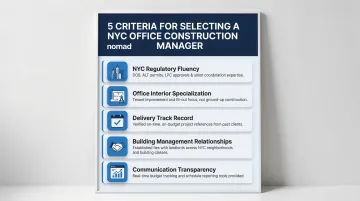
These criteria apply universally — but how you weight them depends on your tenant profile.
Match Firm to Tenant Profile
Tenant needs vary significantly:
- High-growth startups on tight timelines need firms with compressed delivery capability and leasing integration
- Enterprise tenants with complex phased occupancy need firms with the project management infrastructure to coordinate across multiple floors and timeframes
- ESG-focused companies should look for LEED expertise built into the CM's standard process — not offered as an add-on
Apply these criteria to your specific situation first. A firm that's perfect for a 50-person tech startup won't necessarily serve an enterprise tenant coordinating a 10-floor phased move.
Frequently Asked Questions
What does a construction management firm do for office tenants in NYC?
A construction manager acts as the tenant's representative throughout the buildout — coordinating design, selecting and overseeing subcontractors, managing NYC DOB permit filings, and tracking budget and schedule. Unlike a general contractor, the CM's primary obligation is to the tenant, not to executing the work at the lowest cost to themselves.
What's the difference between a general contractor and a construction manager for office space?
A GC executes the physical work under a fixed-price contract and holds subcontractor relationships directly. A CM advocates for the tenant's interests across all parties — designers, contractors, building management, and city agencies — keeping the project aligned with lease terms and move-in deadlines.
How long does a typical NYC office buildout take?
Standard tenant buildouts typically run 3–5 months from contract to move-in, covering design, permits, and construction. Nomad Group's 90-day turnaround serves as a benchmark for high-growth tenants with compressed timelines. Projects involving landmark buildings, structural changes, or ALT1 permits take longer.
How much does an NYC office buildout cost per square foot?
Costs vary by scope: basic fit-outs run $150–$190/SF, mid-range professional spaces $200–$250/SF, and high-end environments (trading floors, executive suites) can exceed $300–$500/SF. NYC is the highest-cost fit-out market among major US cities, and union labor in Class A buildings adds 20–30% above non-union baselines.
What is a TI allowance and how does it affect buildout planning?
A Tenant Improvement (TI) allowance is a landlord-funded contribution toward buildout costs, negotiated at lease signing and expressed per square foot — NYC gateway markets peaked at $212/SF before flattening. Your construction manager should review the allowance's scope, disbursement timing, and landlord-approval requirements before finalizing your budget.
Can my broker also manage my office buildout?
Most traditional brokers don't offer construction management. Firms like Nomad Group handle both leasing and buildout under one roof, eliminating the handoff risk that comes with bringing in a separate construction team after lease signing.
The firms that serve NYC office tenants best combine local regulatory knowledge, interior specialization, and a clear accountability structure aligned with the tenant's interests. Nomad Group integrates construction management into the leasing process from day one, so the team guiding your search is the same one delivering your space. Connect with the Nomad team to discuss your buildout timeline.