Executive summary
By Q4, the New York office market moved from debate to execution. Availability tightened unevenly. Demand concentrated in newer, well-located buildings, while commodity space kept lagging despite pressure on pricing.
Leasing held steady, but tenant behavior changed. Decision timelines shortened, tours picked up and “wait and see” strategies largely disappeared, particularly among growth-stage and creditworthy tenants that put quality and certainty first. The market is no longer looking for a bottom. It is recalibrating around quality and long-term efficiency heading into 2026.
Leasing volume and the largest transactions
After a strong Q3 with roughly 9.5 MSF leased, Manhattan carried its momentum into year-end. Q4 leasing reached 11.9 MSF, the most active quarter since late 2019, according to The Real Deal. Activity stayed well above historical averages, driven by tenant urgency, deals already in motion and tightening availability in core submarkets.
Q4 also brought a renewed uptick in Downtown leasing, after three quarters in which demand concentrated north of Canal Street. Large commitments and recommitments in Class A buildings signaled more tenants willing to evaluate Downtown for scale, efficiency and value. Together, these trends put full-year 2025 leasing near 40 MSF, one of the strongest years since before the pandemic.
Large deals did much of the work. Transactions over 50K SF accounted for about 3.8 MSF in the quarter, and deals over 25K SF for about 5.5 MSF.
| Tenant | Building | Size | Deal |
|---|---|---|---|
| Bloomberg L.P. | 120 Park Avenue | 495,753 SF | 11-year renewal and extension covering 20 floors and select lower-level space |
| Moody’s | 200 Liberty Street | 461,000 SF | Lower Manhattan Class A commitment |
| Millennium Management | 399 Park Avenue | 438,000 SF | Headquarters renewal, early December 2025 |
| Ropes & Gray | 1211 Avenue of the Americas | 346,000 SF | Long-term Midtown lease |
Sizes approximate, as reported.
Bloomberg’s renewal keeps the financial data and media company anchored in a 26-story Class A tower in Midtown. Millennium’s renewal secured the hedge fund’s headquarters footprint and underscored steady demand from major financial firms for prime Midtown space. Ropes & Gray’s lease showed the same from top-tier professional services firms: high-quality, transit-accessible space at scale.
Moody’s commitment at 200 Liberty Street reflects a shift Downtown. As Lower Manhattan becomes more residential and mixed-use through office-to-residential conversions, its remaining Class A buildings stand out on cost. They let corporate occupiers secure high-quality, transit-oriented space at a meaningfully more efficient basis than comparable Midtown Class A product.
Politics changed, leasing velocity didn’t
The election of Mayor Zohran Mamdani in late 2025 introduced short-term uncertainty as the industry weighed his affordability and rent stabilization agenda, along with broader tax and regulatory proposals. Real estate executives said publicly that they were watching early signals rather than changing strategy, and some large firms signaled cautious engagement with the new administration, as CoStar reported.
On the leasing side, many brokers report that tours, active requirements and deal timelines have continued, with supply and demand still driving decisions, according to CRE Daily. The market is treating the transition as a moment to watch and evaluate, not an immediate disruption. Capital availability, asset quality and supply constraints still drive leasing and investment.
Availability is the defining shift
Manhattan’s overall office availability compressed again by year-end, settling around 16.1%, down from 16.5% in Q3 and roughly 19% to 20% a year earlier. That is one of the sharpest year-over-year contractions since 2019. The tightening showed up in both direct and sublease inventory.
Where Q3 was defined by strategic execution, Q4 was defined by compression. Requirements narrowed and options thinned as decisions became time-sensitive. Volume held steady but skewed toward deals driven by near-term expirations, delivery constraints and a limited ability to defer. Renewals and in-place expansions accelerated, competitive processes tightened, and well-capitalized tenants moved quickly to secure quality space before year-end inventory disappeared.
Q4 activity was less about optimization and more about certainty.
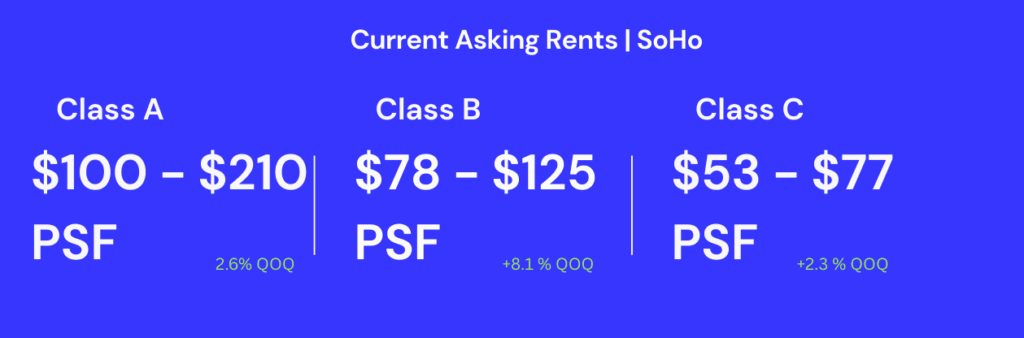
SoHo: scarce inventory, rising asks
Over the past 90 days, SoHo drew down its already limited inventory, with virtually no new supply coming online. The 5,000–10,000 SF segment has become exceptionally scarce as tenants move decisions forward, secure space earlier and commit to renewals and off-market turnkey options well ahead of historical norms.
The quarter was anchored by Scholastic’s sale-leaseback of its longtime headquarters at 555–557 Broadway. The 12-story, 396,000 SF mixed-use building sold to Empire State Realty Trust for $386 million in an all-cash deal, one of the few large office investment trades to close in SoHo this year. Scholastic signed a new 15-year lease for roughly 222,000 SF, with two 10-year renewal options.
The deal sent two signals at once: investor conviction in irreplaceable SoHo loft buildings at scale, and future leasing opportunity, with more than 100,000 SF expected to come online in a submarket where large contiguous blocks are rare.
Across the street at 568–578 Broadway (The Prince Building), asking rents on pre-built suites kept climbing. Newmark’s leasing team was quoting $96–$110 PSF entering Q4. By year-end, with no suites transacted, asks had risen to $120–$125 PSF, an increase of roughly 19% quarter over quarter.
Unicorn Lane: triple-digit rents
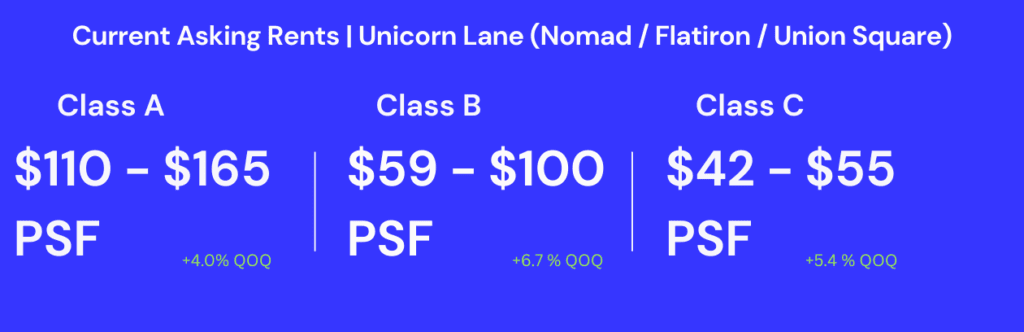
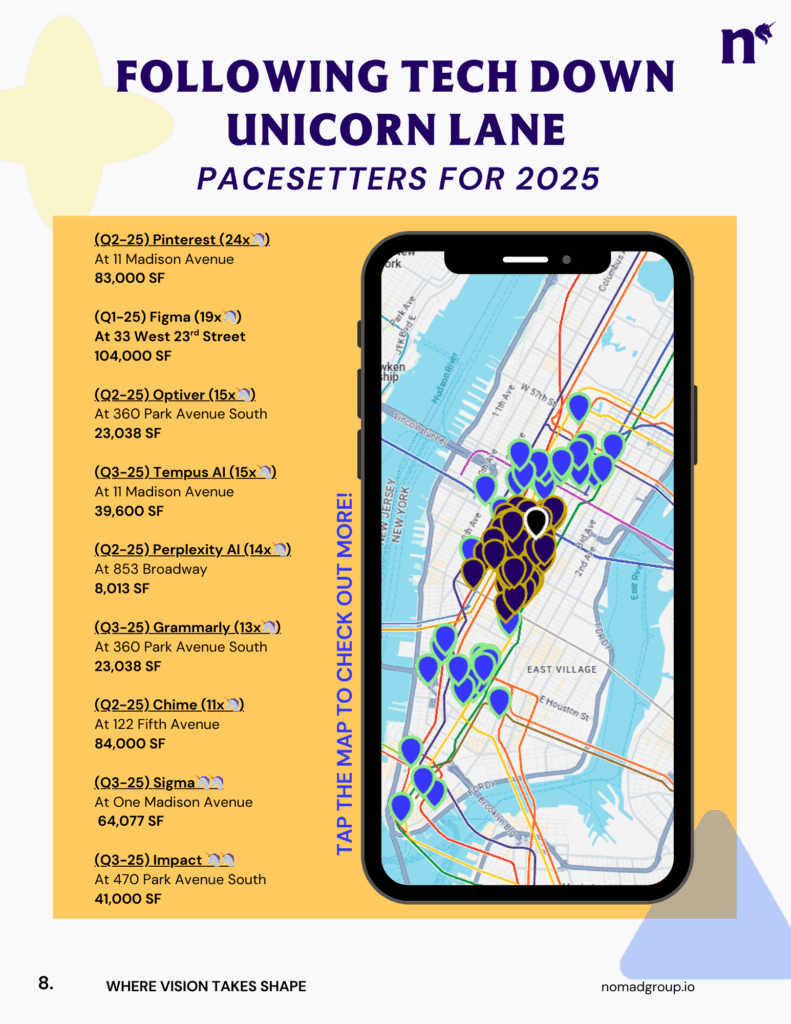
Unicorn Lane recorded some of its highest activity on record in Q4, confirming it as a market driver rather than a niche corridor. Nearly every high-quality offering drew competitive bidding, especially penthouse floors, where scarcity and design-forward layouts attract outsized attention.
At 50 West 23rd Street, Two Trees marketed the 14th-floor penthouse at $81 PSF. Four companies bid, with proposals reaching $88 PSF, a 9% premium to ask. The space was second-generation, previously occupied by Astronomer and Kaiyo, and the owner chose its tenant on credit quality rather than headline economics. That priority hasn’t been this visible since before COVID.
Venture-backed firms have reshaped the corridor. Harvey AI, after a $160M Series F, leased about 92,000 SF at One Madison Avenue, joining Coinbase and Sigma Computing in similarly sized October deals as asking rents climbed to $110–$115 PSF. Farther south, legal-AI firm Legora took two floors at 836 Broadway, where ZG Capital Group is now pricing its last prebuilt floor at $125 PSF.
As highly valued companies prioritize culture, character and transit access, owners along Unicorn Lane are achieving triple-digit rents once reserved for Midtown trophy towers.
Bryant Park South: efficiency under compression
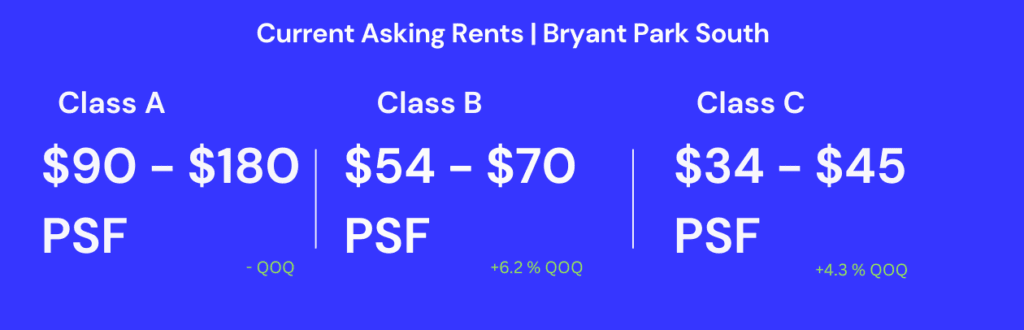
Bryant Park South remained one of Midtown’s most efficient leasing corridors, with demand concentrated around Sixth Avenue and the immediate Bryant Park area. What carried over from Q3 was compression: fewer high-quality blocks, faster decisions and landlords increasingly setting terms as year-end inventory thinned. Midtown’s overall availability fell to around 15%, among its lowest levels since early 2021.
Tenants prioritized certainty, immediacy and transit access, and more deals converted from earlier touring. Well-located, move-in-ready floors traded efficiently, while long negotiations became hard to sustain as alternatives narrowed. For tenants that need scale, the market has favored those who commit early and move decisively.
The notable exception is 340 Madison Avenue, acquired by Barings at auction earlier in the year. Ownership has brought roughly 400,000 SF to market, one of the few opportunities in the area that can take either a single large user or several smaller tenants in custom-built configurations.
Outlook: conversions set up the next shortage
From The Nomad Notion, by William Janetschek, Nomad Group co-founder.
Over the past two decades, New York developers have converted nearly 30 MSF of office space to residential use. What began as a response to downturns has become a structural reallocation of space, now accelerating as office obsolescence, housing scarcity, public policy and design innovation converge.
Office buildings were long seen as poor candidates for conversion. Deep floor plates, limited light and air, and complex mechanical systems made adaptation expensive. Today architects carve light wells, notch structures, remove sections of floorplate and reconfigure cores to make residential layouts work in buildings once considered unconvertible. A significant share of Manhattan’s aging office stock is leaving the commercial market for good.
- The first wave followed the early-1990s recession in Lower Manhattan. Roughly 100 buildings were converted between 1995 and 2006, helped by generous tax incentives.
- The second wave repurposed another 125 buildings totaling 19.5 million SF between 2005 and 2019, largely Downtown, before slowing as office demand recovered.
- The pandemic pushed office vacancy past 20% and reopened conversion at scale. New state and city tax abatements and zoning reforms expanded the pool of eligible buildings, and dozens of projects are now underway, approved or in planning.
Lower Manhattan remains a conversion center, but Midtown is the new frontier. Since the pandemic, roughly half of all announced conversions are in Midtown. Examples include the former Pfizer headquarters on East 42nd Street, 5 Times Square and 750 Third Avenue, an 818,000 SF tower where floorplate surgery will create nearly 680 apartments by the end of the decade.
Every converted building is office supply that won’t come back. With availability already falling and quality space in short supply, conversions are quietly setting up the next office shortage.