Executive summary
Demand stayed resilient in Q3 and availability tightened further. If Q2 2025 felt tight on inventory, Q3 pushed it further: leasing availability contracted again, and premium space grew scarcer as tenant demand kept running ahead of historical averages.
The shift toward higher-quality buildings that defined Q2 continued. Q3 may feel more normal than the headline pace of the previous quarter, but the underlying demand held.
Largest transactions of Q3
Manhattan leased more than 9.5 million square feet (MSF) in Q3, the most active quarter since Q4-19. Many of the largest deals were renewals or expansions, with trophy and Class A landlords signing leases above 200,000 SF with tenants such as American Eagle Outfitters, Samsung, Salesforce and Scotiabank. Most of the big leases stayed in premier Midtown buildings.
WeWork also returned to Manhattan leasing for the first time since its bankruptcy filings, signing a 55,000 SF lease at Moinian Group’s 245 Fifth Avenue.
| Tenant | Building | Total SF | The deal |
|---|---|---|---|
| American Eagle Outfitters | 65 Madison Ave | 392,185 | Added about 54,100 SF, consolidating multiple brand offices under one roof. Asking rents in the building run from the high $70s to the high $80s PSF. |
| Samsung | 277 Park Ave | 316,000 | Renewed and increased its space, a vote for prime Midtown office. |
| Salesforce | 3 Bryant Park | 310,500 | Expanded by 71,000 SF through 2029 for training, hybrid work and customer innovation. |
| Amazon | 1440 Broadway | 259,000 | An expansion that brings Amazon to about 560,000 SF in the building, where it is now the anchor tenant. |
Deals completed over 50K SF in Q3: 22, totaling 3.1 MSF. Over 25K SF: 35, totaling 3.6 MSF.
The Amazon deal was one of the largest office leases in New York in August 2025. 1440 Broadway is a 25-story, 745,000 SF tower near Bryant Park, owned by CIM Group and operated by WeWork.
Q3 builds on Q2 momentum
A strong first half
After a record start to the year, leasing cooled from the Q1 spike in Q2 but stayed historically strong, with nearly 9 MSF transacted. By the end of the first half, activity totaled more than 20.6 MSF, up more than 36% year over year and the most active start since 2014.
A sustained pace
Q3 kept Manhattan on track to exceed 40 MSF of annual leasing for the first time since 2019. The quarter lacked the blockbuster deals of Q1, but volume matched or slightly exceeded Q2. Large transactions of 50,000 SF and up continued, in a mix of relocations, renewals and expansions.
Supply pressure
Availability is the biggest change between the two quarters. Manhattan’s overall availability rate fell to roughly 16.4% by the close of Q2, down sharply from nearly 20% a year earlier. Q3 extended the trend, with both direct and sublease availability contracting. Sublease space, once the mark of pandemic-era oversupply, is at its lowest level in years.
| Q2 2025 | Q3 2025 | |
|---|---|---|
| Volume | Nearly 9 MSF, cooling from the Q1 surge | 9.5 MSF, matching or slightly above Q2 |
| Character of deals | Broad range of transactions | Strategic moves: renewals, consolidations and selective relocations |
| Supply | Availability down to roughly 16.4% | Direct and sublease availability tightened further |
SoHo: a tight market for a premium brand presence
Over the past 90 days, SoHo’s limited inventory has been absorbed faster, with very little replenishment in sight. The 5,000 to 10,000 SF sweet spot is almost nonexistent, and companies are locking in space at record speed. Many of the most desirable turnkey spaces never reach broad marketing.
Instead of the usual 6–8 month lead time for a 10,000 SF renewal, it’s not uncommon to see discussions begin a full year or more in advance.
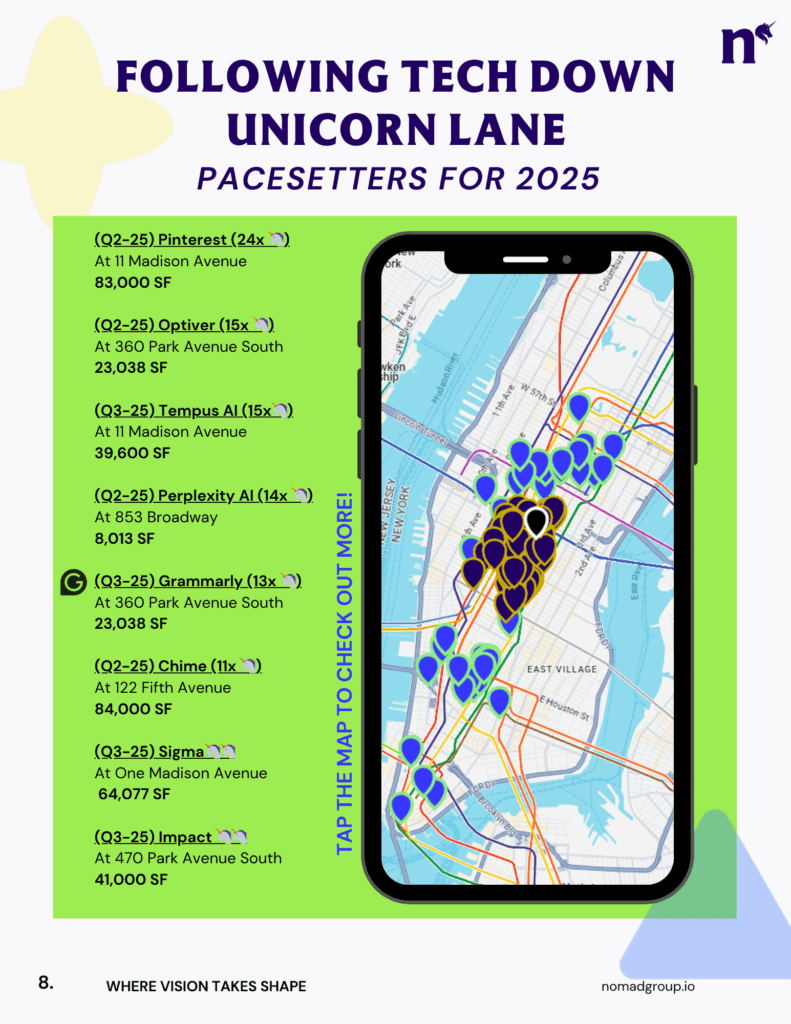
The Q2 momentum, driven largely by AI startups with new venture capital, accelerated in Q3. Following companies like OpenAI, a new wave of Series A and B companies is moving into SoHo. Among them, Alexis Ohanian’s venture firm, Seven Seven Six, leased an entire building at 216 Lafayette Street.
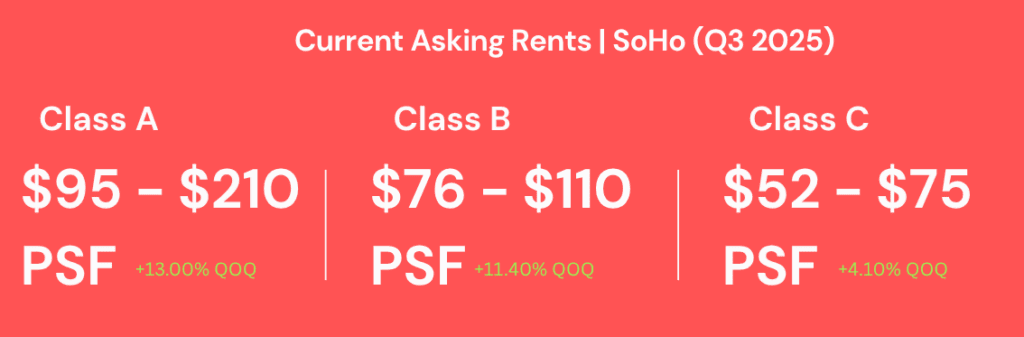
Asking rents kept climbing. Class A space now sits between $95 and $185 PSF, depending on size, build-out and whether furniture is included. Fully built, plug-and-play space on Greene, Spring and Crosby Streets commands the steepest premiums and often leases within days. Class B has appreciated too: 96 Spring Street asks $95 PSF on its lower floors and $110 PSF on tower floors 7 and 8.
Nomad’s Choice: 96 Spring Street, entire 7th floor (7,415 SF), $68K per month, with a tenant rooftop.
NoMad: the upward trajectory holds
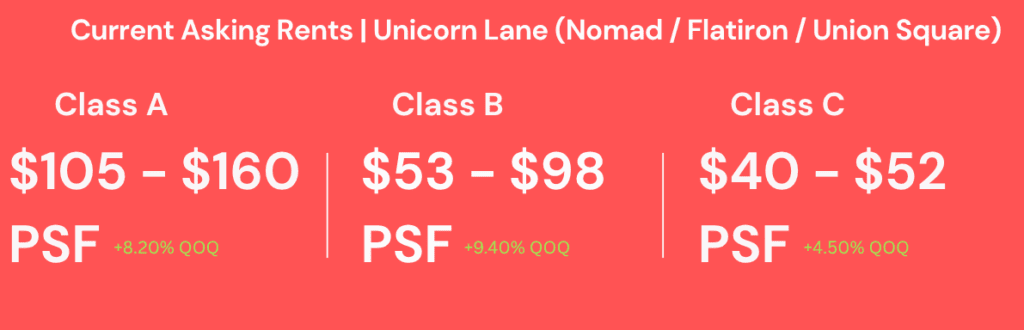
Demand in NoMad stayed steady and pricing power kept tilting toward landlords across building classes. Verified Q2 data shows the average asking rent rose from $49.75 PSF in Q1 to $51.00 in Q2. Early reports indicate Q3 continued the climb, to about $53.00 PSF, as larger tenants absorbed the remaining space. NoMad still offers a substantial discount to SoHo, which is creating urgency as availability shrinks.
At 799 Broadway, just one office floor is left, and it is asking $160 PSF, even though it is the building’s least desirable floor, with limited light at the base where 801 Broadway blocks it along East 11th Street. It is expected to lease before year-end.
As Union Square and Flatiron tightened in Q2, more tenants moved north of Madison Square Park into NoMad. The neighborhood remains Manhattan’s most balanced commercial submarket, drawing creative startups, venture-backed firms and established companies. Grammarly is staying in NoMad, signing for 23,322 SF at BXP’s fully redeveloped 360 Park Avenue South.
Class A pricing now spans $105 to $160 PSF. Class B has climbed into the $50s PSF, and some landlords are pushing higher: new prebuilts on floors 2 to 4 at 37 East 18th Street are listed at $98 PSF.
Nomad’s Choice: 215 Park Avenue South, partial 18th floor (12,660 SF), $68.5K per month.
Bryant Park South’s value edge
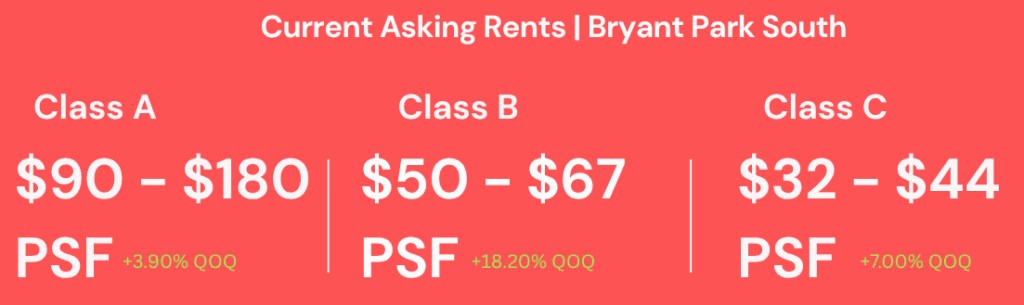
Bryant Park South showed no sign of slowing in Q3. What was steady in Q2 became more competitive, with tenants acting decisively and landlords gaining leverage. Deals were executed at a faster, more consistent pace, a sign that touring earlier in the year turned into signed leases.
The largest was Amazon’s 259,000 SF at 1440 Broadway, at 40th Street and Avenue of the Americas. It brings Amazon to about 560,000 SF in the building and about 3.4 MSF leased and owned across Manhattan.
With activity rising and concessions tightening, the submarket looks set for steady absorption through year-end. For tenants who value accessibility, budget discipline and move-in-ready space, it offers strong long-term value per square foot.
Nomad’s Choice: 1450 Broadway, partial 6th floor (6,919 SF), $35K per month, with a private terrace.
Outlook
Leasing in both quarters reflected tenants committing to long-term decisions. The steady pace of deals has kept momentum without overheating, which points to a more sustainable cycle, with Manhattan on course to pass 40 MSF for the year. On the supply side, expect less choice: top-tier, move-in-ready space is what is driving serious demand, and there is less of it each quarter.
The Nomad Notion: breaking the stalemate
By William Janetschek, COO and Co-Founder, Nomad Group
With top-quality space already spoken for, bidding wars breaking out and almost no new availability reaching the market, the search for the right workspace feels more competitive than ever. For landlords, the challenge is capturing long-term value when flexibility drives tenant decisions.
Many raw spaces have real potential, but there is a gap in term length. Landlords require five-year commitments to justify the cost of a full build-out. High-growth tenants typically need two to three years before their business outgrows the space. Landlords want stability; tenants want flexibility.
- Landlords won’t fund a build-to-suit with a 24-month breakeven on a three-year term, so they are more inclined to hold the space.
- Tenants are pushed into five-year commitments that outlast their growth plans.
That mismatch has left prime spaces idle even as demand grows. Our approach is to bridge it: align the landlord’s investment with the tenant’s need for flexibility, so owners get clearer underwriting on term and tenants get a right-sized commitment. We do this through three tailored strategies.