Introduction
Commercial tenants expect seamless communication, fast issue resolution, and complete transparency from their landlords and property managers. Yet a fundamental gap exists: 75% of CRE professionals believe their tenants receive important building information, while only 25% of tenants agree — a 50-point confidence chasm that reveals how manual, reactive processes fail at scale.
Property management software is often positioned as an operational efficiency tool for landlords. Its most meaningful impact, though, shows up in the daily experience of the people actually occupying the space.
When maintenance requests disappear into email threads, lease expirations catch teams off-guard, and basic information requires a phone call to access, tenant frustration compounds fast. Closing that gap requires the right systems — and understanding exactly where they make a difference.
TL;DR
- Property management software consolidates maintenance, communication, payments, and lease data — eliminating friction from daily tenant interactions
- The three highest-impact areas are faster maintenance resolution, transparent self-service access, and proactive lease renewal management
- Without these systems, managers face reactive firefighting and higher turnover — replacing one tenant can cost more than 90% of a full year's rent
- Maximum value comes from consistent platform use across all functions, paired with proactive human management — not a set-and-forget tool
What Is Property Management Software?
Property management software is a digital platform that centralizes operational tasks — maintenance requests, communications, payments, lease documents, and reporting — into a single accessible system. In commercial and office environments specifically, it plays a critical role managing tenant relationships at scale, where multiple stakeholders, service vendors, and lease terms interact simultaneously.
The real measure of any platform is what it eliminates: scattered email threads, manual spreadsheets, and paper-based processes that slow everyone down. When those get replaced by structured digital workflows, both property managers and tenants get faster responses, fewer miscommunications, and a clearer picture of lease status, open requests, and upcoming obligations.
Key Advantages of Property Management Software for Tenant Satisfaction
The three advantages below are grounded in operational outcomes landlords and property managers can actually track — not abstract efficiency claims.
Advantage 1: Faster Maintenance Resolution and Facilities Visibility
Property management software replaces informal, phone-based maintenance reporting with structured digital workflows. Tenants submit requests through a portal, managers assign and track work orders, and both parties see real-time status updates.
When a tenant submits a maintenance request digitally, it is immediately logged, timestamped, and routed to the right vendor or team. This eliminates the communication gap that causes the most frustration — the period where tenants hear nothing after submitting a request.
Why this matters:
Research shows that a one-point increase in tenant satisfaction (on a 1-to-5 scale) corresponds to an 8.62% higher willingness to renew and a 15.80% lower probability of moving out. Maintenance response is one of the specific touchpoints tracked in these satisfaction surveys, meaning improvements in maintenance resolution directly feed the scores that drive financial outcomes.
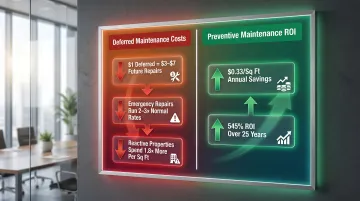
The cost escalation from deferred maintenance is severe:
- Every $1 of deferred maintenance typically costs $3–$7 in future repairs
- Emergency repairs run 2–3x normal rates
- A JLL study of 14 million sq ft found preventive maintenance delivers $0.33/sq ft annually over reactive approaches — with proactive programs generating a 545% ROI over 25 years
KPIs impacted:
- Average maintenance resolution time
- Tenant satisfaction survey scores
- Lease renewal rates
- Emergency repair frequency and cost
When this advantage matters most: High-traffic commercial properties with multiple tenants, shared amenities, or aging infrastructure where maintenance volume is high and coordination complexity is significant.
Advantage 2: Transparent Communication and 24/7 Self-Service Access
Property management software provides tenants with a dedicated portal where they can access lease agreements, payment histories, submitted requests, building notices, and contact information — at any time, without needing to call or email management.
Instead of tenants chasing answers through phone calls or unread emails, all relevant information lives in one place. Automated notifications handle routine updates — rent reminders, lease renewal alerts, maintenance status changes — so tenants stay informed without manual effort from the management team.
Why this matters:
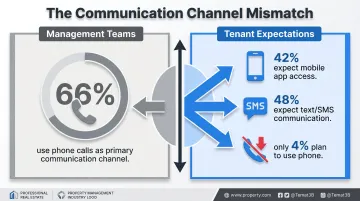
66% of management teams use phone calls as a primary communication channel, but only 4% of tenants plan to use phone-based communication in the future. Meanwhile, 42% of tenants expect mobile app access and 48% expect text/SMS. This channel mismatch creates a structural communication failure that no amount of effort can overcome without updating the tools.
Transparency in billing, maintenance tracking, and lease terms builds trust — especially in commercial settings where lease terms are complex and tenants are businesses, not individuals.
Tenants who feel a complaint was heard are more likely to renew than those whose issues were resolved but never acknowledged. Communication quality matters as much as resolution speed.
KPIs impacted:
- Response time to tenant inquiries
- Number of escalated complaints
- Tenant satisfaction survey scores
- Rate of lease renewal initiation
When this advantage matters most: Multi-tenant commercial buildings, portfolios where one management team oversees multiple properties, and high-growth companies whose space needs and questions evolve frequently throughout a lease term.
Advantage 3: Proactive Lease Management and Renewal Engagement
Property management software tracks lease expiration dates, sends automated renewal alerts to both managers and tenants well in advance, and stores all lease documentation digitally — making renewal conversations proactive instead of reactive.
Rather than discovering a lease is expiring 30 days out and scrambling to retain the tenant, managers receive early alerts that allow them to initiate renewal discussions, offer space adjustments, and demonstrate proactive investment in the tenant relationship.
Why this matters:
JLL's analysis shows that the total cost of re-letting a commercial office space — covering refurbishment, vacancy, marketing, brokerage, and new tenant incentives — can exceed 90% of one year's net rent. In one detailed example, re-letting costs came within 10% of a full year's income. Brokerage fees alone typically run 8–12% of annual rent.
Tenants who feel their landlord is engaged and forward-thinking are more likely to renew. A software-driven renewal process signals professionalism and organization. Nomad Group's full-service model — which combines in-house asset management with tech-enabled systems — approaches lease lifecycle management as an ongoing relationship rather than a transactional process, creating the continuity that supports long-term tenant retention.
KPIs impacted:
- Lease renewal rate
- Average vacancy duration between tenants
- Tenant retention rate
- Revenue stability per asset
When this advantage matters most: Multi-property portfolios, long-term commercial leases with option periods, and growing companies whose space needs shift over time.
What Happens When Property Management Software Is Missing or Ignored
Without property management software, the operational reality looks like this: maintenance requests get lost in inboxes, lease expirations are caught late, rent tracking relies on spreadsheets, and tenant communication defaults to inconsistent phone and email threads. Each creates a different failure mode.
The compounding effect on tenant satisfaction:
- Maintenance requests that go unanswered for days — or return conflicting answers from different team members — erode tenant trust quickly
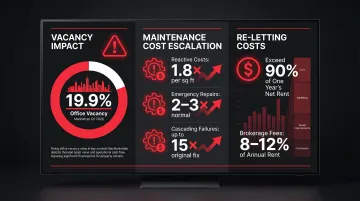
- Ignored tenants don't renew; in NYC, where Manhattan office vacancy hit 19.9% in Q1 2026, losing a quality tenant carries real financial weight
- Reactive maintenance costs far more than prevention: bottom-quartile properties spend 1.8x more per square foot, emergency repairs run 2-3x normal rates, and cascading deferred failures can reach 15x the original fix
Owner-side risk: Declining tenant satisfaction doesn't just affect renewals — it affects the asset's reputation. Appraisers now model properties with strong tenant satisfaction data with lower vacancy risk and shorter downtime between tenants, meaning management quality flows directly through to asset valuation.
The operational upside of fixing this is concrete. Hospitality at Work (a Lowe subsidiary) had 28 engineers manually processing paper-based maintenance workflows before centralizing their systems. After consolidating operational, financial, leasing, and maintenance data into a single platform, the firm doubled in size — growth that would have been operationally impossible without the infrastructure to support it.
How to Get the Most Value from Property Management Software
The software's impact on tenant satisfaction is directly proportional to how consistently it is used. Irregular usage or partial adoption — such as only using the rent collection module — limits value significantly.
Conditions for maximum return:
- Use all available functions — communication, maintenance, lease management, and reporting — to create a unified tenant experience rather than a patchwork of digital and manual processes.
- Review platform data regularly — average response times, open maintenance requests, upcoming lease expirations — to make proactive decisions rather than reactive ones.
Software removes friction but doesn't replace judgment or relationships. The strongest outcomes come when well-configured platforms are backed by an attentive management team.
Nomad Group applies this model across its commercial property management and facilities work, where digital tools combine with on-the-ground expertise to deliver a responsive tenant experience. The company's in-house integration of brokerage, construction, facilities, and asset management ensures consistency across every touchpoint — eliminating the miscommunication and service gaps that occur when landlords rely on fragmented external vendors.
Conclusion
Property management software improves tenant satisfaction not by being impressive technology, but by eliminating the specific friction points : delayed maintenance responses, communication gaps, and reactive lease management that cause tenants to lose confidence in their landlord.
The advantages described here build on each other over time. A tenant who experiences fast maintenance resolution, transparent communication, and proactive lease engagement doesn't just stay longer; they become an advocate for the property.
In a market where Manhattan overall office vacancy hovers near 20% while prime vacancy sits at just 2.9%, the gap between well-managed and poorly managed buildings creates a measurable competitive and valuation divide.
Treating property management software as an active management tool (reviewed regularly, used consistently, and backed by real human expertise) is what separates landlords who retain great tenants from those who are constantly starting over. The buildings that win long-term occupancy aren't necessarily the newest — they're the ones where tenants feel heard, informed, and valued from day one.
Frequently Asked Questions
Is property management software worth the cost?
JLL data shows that re-letting a single office space costs over 90% of one year's net rent. Proactive maintenance programs deliver a 545% ROI over 25 years and save $0.33 per square foot annually — making software adoption a straightforward financial decision for multi-tenant portfolios.
What are the benefits of using property management software?
Core benefits include faster maintenance resolution through digital work order tracking, centralized communication via tenant portals, simplified rent tracking and automated payment processing, proactive lease management with automated renewal alerts, and improved data visibility for decision-making across portfolios.
How to reduce expenses in property management?
Software reduces costs through automation (reducing manual administrative labor), faster maintenance response (preventing issue escalation that multiplies repair costs 3-7x), and higher tenant retention (avoiding vacancy carrying costs, brokerage fees, and tenant improvement allowances that exceed 90% of annual rent).
How does property management software improve tenant retention?
Retention improves when tenants feel heard, informed, and well-served. Software delivers that consistency through proactive lease renewal management that starts conversations early, plus maintenance communication that acknowledges requests immediately and keeps tenants updated throughout resolution.
What features matter most for commercial tenant satisfaction?
The highest-impact features include:
- Maintenance request tracking with real-time status updates
- Self-service tenant portal for lease documents and payment histories
- Automated notifications for routine updates and reminders
- Lease management tools that trigger renewal conversations well before expiration
Can property management software replace human property management?
No. Software handles process consistency and data organization, but human expertise remains essential for relationship management, navigating complex decisions, and the situational judgment that defines a strong tenant experience. The two work best together — software removes friction, while people provide the strategic thinking and personal attention that no platform replicates.