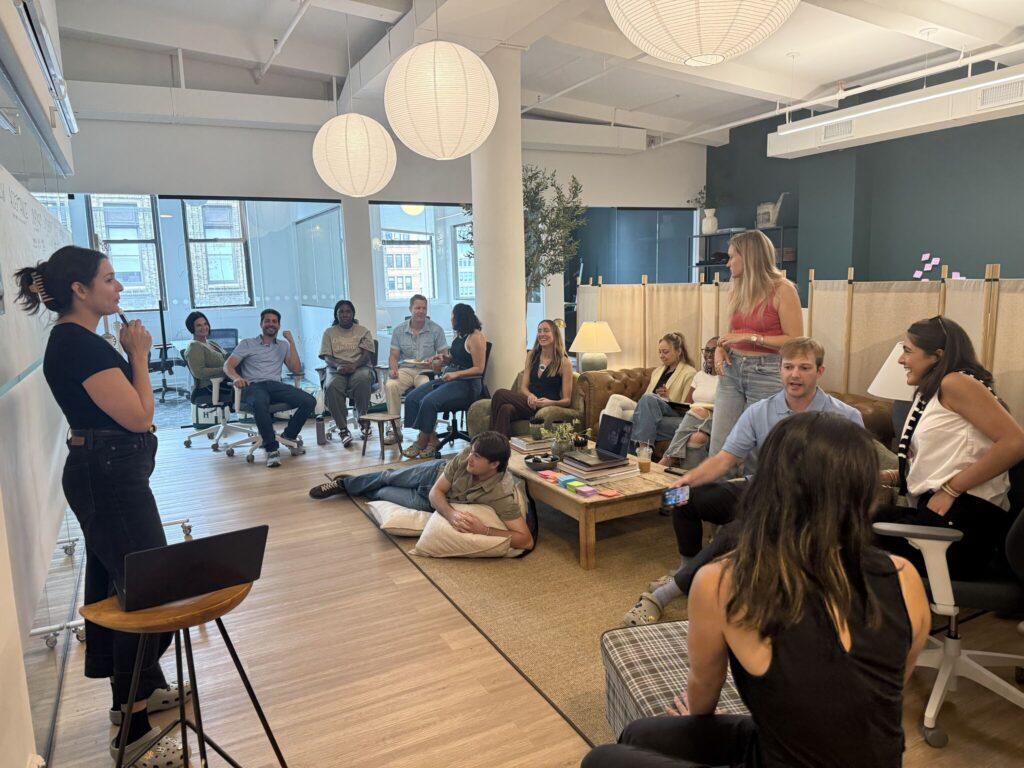
The shared office was once the flexible, affordable answer for a growing company. For many, it no longer is. The lack of privacy and branded space, rising costs and thinning service have left companies looking for something better. The newer all-inclusive alternatives help, but often come with hidden markups.
How we got here
Fifteen years ago, New York leasing looked very different. Tech startups were moving from Silicon Valley to Silicon Alley, and giants like Google anchored themselves in Chelsea. Lean startups were building communities as well as products. WeWork rode that wave, redefining office space with flexible leases, all-inclusive billing and hospitality-style amenities.
Flexibility and high-touch service are still in demand. What has changed is the definition of community.
Life in the fishbowl
Imagine spending your life in a fishbowl, circling with the same familiar faces. Eventually you would struggle to find your own identity. That is the shared office. There is plenty to gain from being around the big fish as you grow, but building a company in such a transparent, confined space can leave it feeling indistinct.
Companies are built on culture, whether it is fast and loud, slow and measured, or work hard, play hard. Without a distinct culture, it is hard to see what people are really building. The CEO of Idea Foundry put it simply: "People want to feel like they are a part of something."
The shared office offers extreme flexibility. But without a commitment to a specific company, employees start committing to the space itself.
There is another view. Some see the fishbowl as a melting pot of ideas, a place to grow through new conversations. JLL has noted that "coworking spaces are getting people out of their homes." That matters, but a growing brand still needs a defined identity.
Amenities are up everywhere, except in the fishbowl
Amenities are one of the hottest parts of the market. Golf simulators, rooftop bars and tenant-only gyms are near the top of companies' priorities, and shared spaces were the first to capitalize on that demand. Now their service and amenities are slipping. Why pay premium prices for yesterday's bagel, or for limited time in the conference room?
The "New Gen" shared office
A newer kind of shared office has emerged, led by companies like Knotel. These providers sublease anything from a conference room to a company's entire office at one all-inclusive rate. They market dedicated, furnished, private space on a single bill, without the complications of a long-term lease, and with demand high they charge a 50-60% premium.
Is it a real alternative or a more polished version of the same model? Research from JLL indicates that companies can save up to 25% in upfront costs by choosing furnished, all-inclusive space. Imagine how much more they would save without the markup.
A different model
We launched Flex by Nomad in response. Its all-inclusive pricing includes high-end furniture and a dedicated Office Success Manager. Here is how it compares with the typical New Gen offer:
| Typical New Gen | Flex by Nomad | |
|---|---|---|
| Monthly rent markup | 50-60% | 25% |
| Furniture | Budget, off-the-shelf | Poppin, Branch, AIS or custom |
| Buildings | Class C, which increases the rental margin | Renovated Class B |
| Term | 6-12 month license | 1-3 year license, with a termination option |
| Service | Minimal | A dedicated success professional for custom paint and signage, access control and daily requests |
As described by Nomad. Compare the full terms of any offer.
Hampton, a founder community, was the first company to join Flex by Nomad. It needed a private, branded hub for its members, and a premium space was a prerequisite. The result is a 5,000 SF space in NoMad on one all-inclusive monthly bill.
If you are leaving coworking but aren’t ready for a long lease, look past the monthly number on any all-inclusive offer. The markup, the class of building and the length of the term decide whether the convenience is worth the price. And the space itself should let your company look and feel like itself, not like the fishbowl it just left.